In April 2019, I was working in an NHS hospital as an HCPC-registered paramedic. The Bank was once again pursuing repossession on the basis of arrears that I say it knew did not exist. Its own instruction to its solicitors on 2 April 2019 recorded my previous hospital treatment for depression two years earlier, when it was also threatening repossession on the same basis, but that information was only in the Service’s file because I provided it.
The escalation before April 2019
Letters, calls and litigation decisions from the disclosed records, compared with the Bank’s later reconstruction. On every dated event below, that reconstruction records nil arrears, even under its limited 1.25-percentage-point correction.
The escalation, event by event 22 letters, calls and decisions · 3 blacked-out runs
The amounts labelled “alleged” come from the dated documents; a dash means no amount is listed here for that call. The black boxes represent individual wholly redacted pages from Topaz’s DSAR. Each run is shown where it sits in Topaz’s own disclosure, between the dated documents either side of it; what the pages contain is unknown. These are representations of the blacked-out pages, not reproductions of readable material.
27 October 2018
Payment shortfall letter
Arrears alleged in this document: £1,024.67
Period 2B bundle pp.44 · Reconstruction: E-CON-14 p.36
Reconstructed arrears£0
16 November 2018
Payment shortfall letter and field-agent warning
Arrears alleged in this document: £1,024.67
Period 2B bundle pp.45–46 · Reconstruction: E-CON-14 p.36
Reconstructed arrears£0
16 November 2018
Separate quarterly arrears notice
Arrears alleged in this document: £1,024.67
Period 2B bundle pp.47–52 · Reconstruction: E-CON-14 p.36
Reconstructed arrears£0
23 November 2018
Warning that payment was required
Arrears alleged in this document: £2,049.34
Period 2B bundle pp.53–54 · Reconstruction: E-CON-14 p.37
Reconstructed arrears£0
26 November 2018
Incoming call, connected
Arrears alleged in this document: —
Period 2B bundle pp.55–58 · Reconstruction: E-CON-14 p.37
Reconstructed arrears£0
27 November 2018
Payment-arrangement confirmation letter
Arrears alleged in this document: £1,024.67
Period 2B bundle pp.59–60 · Reconstruction: E-CON-14 p.37
Reconstructed arrears£0
4 February 2019
Letter saying the payment arrangement had ended
Arrears alleged in this document: £3,074.01
Period 2B bundle pp.63–64 · Reconstruction: E-CON-14 p.38
Reconstructed arrears£0
4 February 2019
Outgoing call attempt, unsuccessful
Arrears alleged in this document: —
Period 2B bundle pp.58, 62 · Reconstruction: E-CON-14 p.38
Reconstructed arrears£0
5 February 2019
Outgoing call attempt, unsuccessful
Arrears alleged in this document: —
Period 2B bundle pp.62 · Reconstruction: E-CON-14 p.38
Reconstructed arrears£0
6 February 2019
Intention to start repossession proceedings; 15 working days to contact the firm
Arrears alleged in this document: £3,074.01
Period 2B bundle pp.65–66 · Reconstruction: E-CON-14 p.38
Reconstructed arrears£0
11 February 2019
Incoming call, connected. The call record confirms a £1,024.67 payment that day.
Arrears alleged in this document: —
Period 2B bundle pp.67–70; payment at 68 · Reconstruction: E-CON-14 p.38
Reconstructed arrears£0
12 February 2019
Arrears warning requiring payment—the day after the recorded payment
Arrears alleged in this document: £2,049.34
Period 2B bundle pp.71; related copy at 54 · Reconstruction: E-CON-14 p.38
Reconstructed arrears£0
18 February 2019
Quarterly arrears notice, six days after the warning
Arrears alleged in this document: £2,049.34
Period 2B bundle pp.72–74 · Reconstruction: E-CON-14 p.38
Reconstructed arrears£0
25 February 2019
Servicing diary: “Case reviewed: No Field Agent” and “NOFA due to recent I&E and FFF”: no field agent, because of my recent income and expenditure. The next day the Bank warned of repossession.
Period 2B bundle pp.75; related copy at 66 · Reconstruction: E-CON-14 p.38
Reconstructed arrears£0
19 March 2019
Final repossession warning: pay or make an arrangement, otherwise referral to solicitors
Arrears alleged in this document: £3,074.01
Period 2B bundle pp.84–85 · Reconstruction: E-CON-14 p.39
Reconstructed arrears£0
Topaz DSAR: 6 wholly blacked-out pages
Topaz Batch 5 pages 63–68 (review-bundle pages 78–83). In Topaz’s disclosure these pages sit between the 19 March 2019 repossession warning and the 26 March 2019 litigation letter. Their contents are unknown, and no arrears figure is assigned to them.
Show the 6 pages
Topaz DSAR REDACTED
Bundle p.78 Topaz Batch 5 p.63
Topaz DSAR REDACTED
Bundle p.79 Topaz Batch 5 p.64
Topaz DSAR REDACTED
Bundle p.80 Topaz Batch 5 p.65
Topaz DSAR REDACTED
Bundle p.81 Topaz Batch 5 p.66
Topaz DSAR REDACTED
Bundle p.82 Topaz Batch 5 p.67
Topaz DSAR REDACTED
Bundle p.83 Topaz Batch 5 p.68
20 March 2019
Internal referral recommending commencement of litigation. The servicing diary moves the account to the “Holding Queue” the same day, two days before my March payment was due.
Internal decision authorising commencement of litigation
Arrears alleged in this document: £3,074.01
Period 2B bundle pp.90–91 · Reconstruction: E-CON-14 p.39
Reconstructed arrears£0
26 March 2019
Litigation referral letter: account transferred back to solicitors to recommence legal action
Arrears alleged in this document: £4,098.68
Period 2B bundle pp.92 · Reconstruction: E-CON-14 p.39
Reconstructed arrears£0
26 March 2019
Separate litigation-transfer letter and arrears statement; possession proceedings described as the next stage
Arrears alleged in this document: £4,098.68
Period 2B bundle pp.93–94 · Reconstruction: E-CON-14 p.39
Reconstructed arrears£0
30 March 2019
Solicitors to continue legal action; £22 charged, with any new repayment arrangement required to be secured by a suspended court order
Arrears alleged in this document: £4,098.68
Period 2B bundle pp.95–96 · Reconstruction: E-CON-14 p.39
Reconstructed arrears£0
Topaz DSAR: 7 wholly blacked-out pages
Topaz Batch 5 pages 78–84 (review-bundle pages 98–104). In Topaz’s disclosure these pages sit between the annual statement to 31 March 2019 and MAS5’s letter of 10 April 2019. Their contents are unknown, and no arrears figure is assigned to them.
Show the 7 pages
Topaz DSAR REDACTED
Bundle p.98 Topaz Batch 5 p.78
Topaz DSAR REDACTED
Bundle p.99 Topaz Batch 5 p.79
Topaz DSAR REDACTED
Bundle p.100 Topaz Batch 5 p.80
Topaz DSAR REDACTED
Bundle p.101 Topaz Batch 5 p.81
Topaz DSAR REDACTED
Bundle p.102 Topaz Batch 5 p.82
Topaz DSAR REDACTED
Bundle p.103 Topaz Batch 5 p.83
Topaz DSAR REDACTED
Bundle p.104 Topaz Batch 5 p.84
2 April 2019
Instruction to Walker Morris, recording my previous hospital treatment for depression
Arrears alleged in this document: £4,098.68
Period 2B bundle pp.156 · Reconstruction: E-CON-14 p.39
Reconstructed arrears£0
Topaz DSAR: 5 wholly blacked-out pages
Topaz Batch 5 pages 86–90 (review-bundle pages 159–163). In Topaz’s disclosure these pages sit between MAS5’s letter of 10 April 2019 and account histories printed on 2 April 2019 (the disclosure is not in date order at this point), so they belong to the same early-April 2019 run of documents. Their contents are unknown, and no arrears figure is assigned to them.
Show the 5 pages
Topaz DSAR REDACTED
Bundle p.159 Topaz Batch 5 p.86
Topaz DSAR REDACTED
Bundle p.160 Topaz Batch 5 p.87
Topaz DSAR REDACTED
Bundle p.161 Topaz Batch 5 p.88
Topaz DSAR REDACTED
Bundle p.162 Topaz Batch 5 p.89
Topaz DSAR REDACTED
Bundle p.163 Topaz Batch 5 p.90
Sources: Period 2B, 2018–2019, Service copy, pp.44–96 and 156; redaction source notes at pp.77, 97 and 158. Bank reconstruction E-CON-14, pp.36–39: the reconstructed-arrears column displays a dash for these dates, meaning nil. On 22 March the internal decision form still states £3,074.01; the Bank’s daily as-charged reconstruction records £4,098.68 for that date. The figure above retains what the decision form actually said. Whole-page redactions shown: Topaz Batch 5 pp.63–68, 78–84 and 86–90.
April 2019 and the missing history
After my Addenbrooke’s placement ended in October 2018 I was between clients, and the Bank agreed a nil-payment arrangement for a couple of months, when I say it knew there were no arrears owing. I was back at work by January 2019. The Bank’s call record of 11 February 2019 confirms a £1,024.67 payment that day, and the Ombudsman found that “he had made his monthly payment, and so the arrears were not growing”. My March payment fell due on 22 March. That same day, the Bank’s internal decision form authorised litigation. On the Bank’s own later reconstruction, there were no arrears to pay. At the time I did not realise that I was not in arrears. I say that the Bank realised I was not in arrears.
At the end of March 2019 the Bank told me it was starting legal action. I was finding it very difficult to cope and was very depressed, but I had to keep working to pay the mortgage. Over two days in April I had three road collisions. My head smashed the windscreen, and I have had the effects of a head injury ever since. I never worked again.
The Bank’s own servicing diary records no telephone call with me, in either direction, between 11 February 2019 and 27 April 2019, after my collisions. In that time it wrote on 12 and 26 February that I had not responded to its attempts to contact me, warned of repossession proceedings on 19 March, moved the account to litigation on 23 March and instructed its solicitors on 2 April.
I say years of pressure from the Bank’s enforcement, intensified by the 2019 escalation, caused or materially aggravated my psychiatric breakdown. Documents showing the extent of that earlier enforcement were not in the file the Ombudsman had.
The Ombudsman needs to look at them. Across the record before the Final Decision, 92 enforcement letters or threats were missing from the file as originals, and with 31 further recurring demands the total is 123 (see “The missing enforcement record” on the enforcement page).
My case is that there were never any true arrears. The starting point is the contractual rate, which the restrictive covenant set. It is the Emperor’s new clothes again: the interest rate appeared to track Bank Rate, but the margin tracked only itself, and was based on nothing but itself. Even on the Bank’s own minimal calculation, I was not in arrears in April 2019.
The Service needs to look at the facts, not the assertions: calculate the contractual rate, work out where the mortgage really stood, and apply any limits on redress afterwards. Arrears that exist only because of arbitrary increases to the interest rate are not true arrears. If I simply asserted that the Bank owed me £100,000, nobody would take that as fact, still less set it against the arrears. So why is the Bank’s assertion of arrears treated as fact?
Information the Bank gave the Financial Conduct Authority is relevant to my case. I have asked for permission to share it with the Service; otherwise, to do so would be a criminal offence (FSMA 2000).
The Bank’s different accounts
This is the two-audience problem again. To the Ombudsman, the Co-operative Bank has given false accounts of the restrictive covenant, the date my mortgage was transferred, whether GMAC would have known that my mortgage would be sold on, the arrears position of my mortgage in the decade before the decision, and the funding costs of the mortgages. Yet the investors were given details of the restrictive covenants (I was given them only after the investigation) and the mortgage transfer dates, and GMAC knew the mortgages were likely to be sold on. The Bank had the calculations to show I had no reconstructed arrears in 2019, and eventually showed them to me, but only in 2025; they are not in the Service’s file or its 2024 decision. The two-audience problem →
The Service asked for correspondence twice, on 4 October 2021 and on 31 May 2024, yet its file was missing many of the enforcement letters. Some reached me only through Topaz, whose disclosure has 80 wholly redacted pages, not all at periods of litigation, and hundreds of the pages the Bank disclosed in 2025 lack date fields.
I say the business model was to charge as much as possible, then repossess at the three-month trigger or push borrowers into an assisted voluntary sale. In its own words to investors, non-core books like mine were to be “managed for value” or targeted for “run-down or exit”. The Final Decision does not consider that strategy, or how much the later securitisations distributed. My Ombudsman decided that I'd been treated unfairly in 2019 and litigation action had commenced too quickly. I'm grateful for that finding, because it was the first time I'd seen it written down that I might have been treated badly, and I did thank her for that.
The Bank had several audiences here and gave each a different account of my work. Its own notes were different again. To the Ombudsman, it said: “By October 2018 Mr Jarrett was unemployed and also taking time to help care for his stepfather”. Yet I had worked through the same agency since 2013, and in 2018, because of changes to the tax rules for NHS work, I became its PAYE employee. A locum chooses which shifts to take and who to work for; the days between shifts are not unemployment. Apart from letters and the servicing diary, the file it passed to Topaz contains only three contact notes, out of hundreds of call-note pages in the data the Bank gave me. All three are undated, as in my own copy, and they read as if I had left that career and moved away: one says I “was a paramedic but had an injury and gave up”, another that I was “now working in sheffield”. Nothing on the sheets indicates they are from 2012; only the diary, elsewhere in the file, dates them. In Topaz’s file, they sit immediately before my 2022 witness statement to the High Court, which describes my later work. So the appearance is that I told the High Court I was working as a paramedic in 2019, when the notes beside that statement say I had given up that career. I am, of course, happy to help the Bank and its solicitors, and Topaz and its own, with the facts. I was shocked to see the same documents in the Bank’s own 2025 DSAR response, but even worse: there, the three undated call notes appear both before and after my High Court statement. I took its meaning as intimidation. My statement to the High Court was highly critical of the Bank and its business. This conduct is relevant to my reconsideration request. The Bank’s own notes recorded the truth: “Mr is a self-employed Paramedic who is only paid when he works” (9 January 2017), “Mr is a paramedic so has medical knowledge” (15 August 2019) and, in late 2019, “Mr was employed via an agency as PAYE”. I was working until 10 April 2019, in an NHS hospital, the day before the crash.
Statement of case, FOS case file p.58; Topaz Batch 12, pp.58–59 (the three contact notes, undated) and pp.60–65 (my witness statement of 1 June 2022); the servicing diary dates the “gave up” note 10 October 2012; the Bank’s notes of 9 January 2017 and 15 August 2019; its late-December 2019 note, Co-op DSAR 2(1), p.386 (supplied without a date).
I joined the NHS in 2003, was based from home on a response car from 2005, also took on forensic/custody work for the police from 2006, spent 2007 at university and on placement in hospital, then went back on the car from home responding to 999s from Cambridge down to Stansted. After a nasty injury on duty in 2010, I was back on the road in 2011, and in 2012 and 2013 I was a university lecturer. From 2013 to 2019, I worked in paramedic roles in urgent care and A&E. In March 2017 I was admitted to hospital (see Enforcement and the missing record); I went back to work afterwards, with some teaching in Cambridge, and then locum shifts in Lincolnshire, where I worked until 10 April 2019. I was 49 when I last worked. I’ll copy that to the regulator so the Bank doesn’t have to correct the record.
The FCA material remains withheld. The wider question is how reliably the Bank described my circumstances, and whether the Service accepted its account without the evidence needed to test it. I ask the Service to compare what the Bank said with the records it requested, the documents later disclosed, and the accounts given to other audiences wherever those can lawfully be considered. That evidence needs to be assessed alongside the false statements about the restrictive covenant and the transfer of my mortgage. The Service must examine what my account—and my own financial position—would have been if the Bank had charged only what it was entitled to charge from December 2008 onwards, when I say the covenant was first breached. It must also consider what I could have understood and challenged at that time if the protection had been disclosed to me.
The Bank’s conduct since the decision is relevant: I say it is indicative of its conduct before the decision, evidence of which was concealed from the Service.
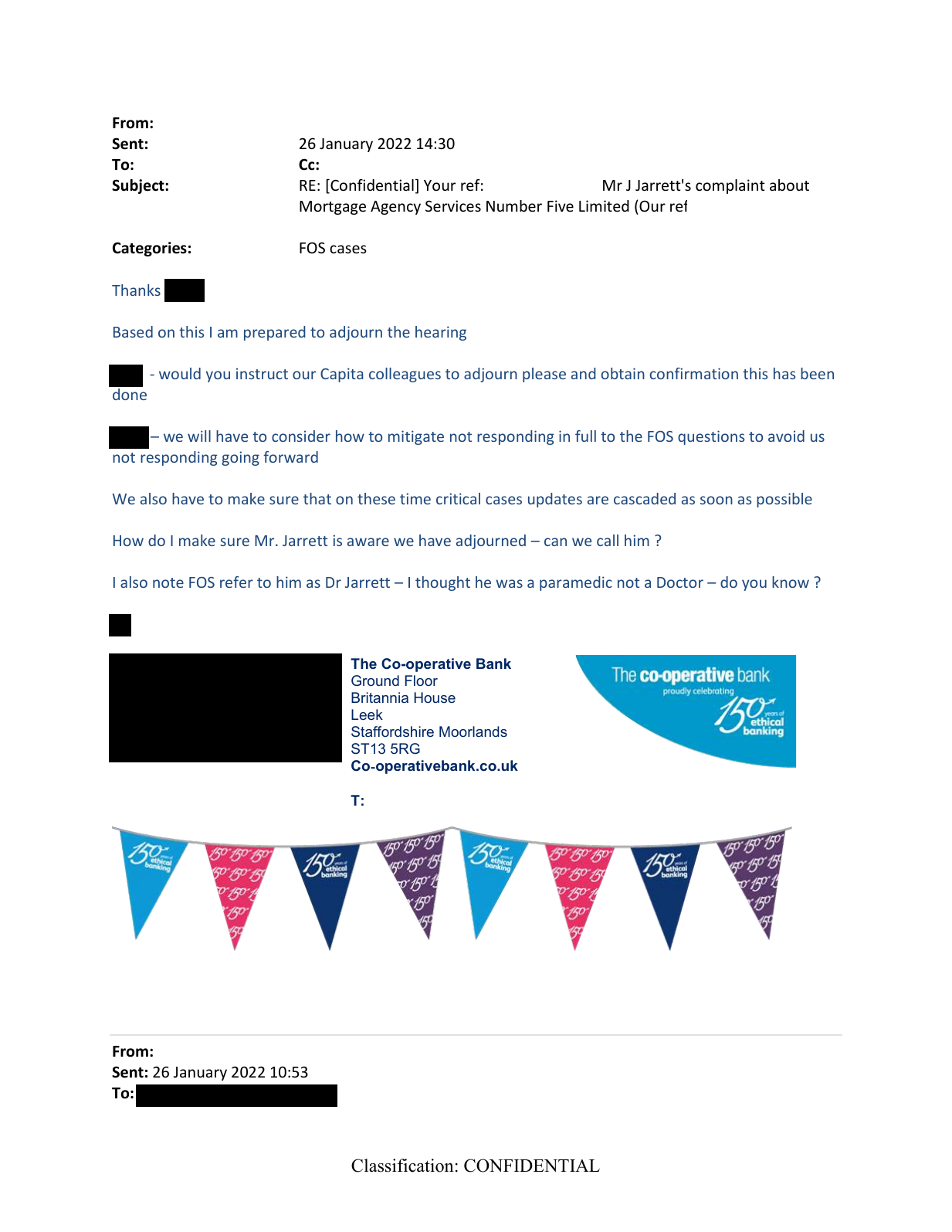
My paramedic registration, 2005–2025My registration lapsed in 2025; the Bank’s alternative facts place that date thirteen years earlier.The Service needs to see the evidence, not be guided by the assertion.The HCPC’s confirmation of 10 October 2026 records my first registration on 14 April 2005, my last registration period to 31 August 2025, deregistration for non-renewal on 3 September 2025, and no fitness to practise sanctions. My date of birth and address are redacted.Open the HCPC confirmation at full size ↗What the Bank itself wrote in 2022The full page of the Co-operative Bank’s internal email of 26 January 2022, including “I thought he was a paramedic not a Doctor” and “we will have to consider how to mitigate not responding in full to the FOS questions”. Case references, staff names and direct contact details are masked in this website copy.Open the full Bank email page ↗
The request, the answer and the later April rows
The calculation the Ombudsman asked for—and what the Service received
The Ombudsman asked for the lower-rate account position and arrears from 2014 onward (the Service’s cut-off, which I dispute). The Bank’s 5 June reply said the calculation was complete, but enclosed an R172 transaction report for the account as charged. That report has a running as-charged “Balance” column—not the recalculated balance and corrected arrears history she requested. The later April 2019 rows below were not included in that reply.
01 · The request · 31 May 2024
The corrected account history requested
The investigator asked what the account position would have been from 2014 onward if the lower interest rate had applied, including the effect on arrears present from time to time. The request also sought contact notes and correspondence.
E-FOS-11, pp.1–2. The website viewer masks personal identifiers; the source PDF remains unchanged.
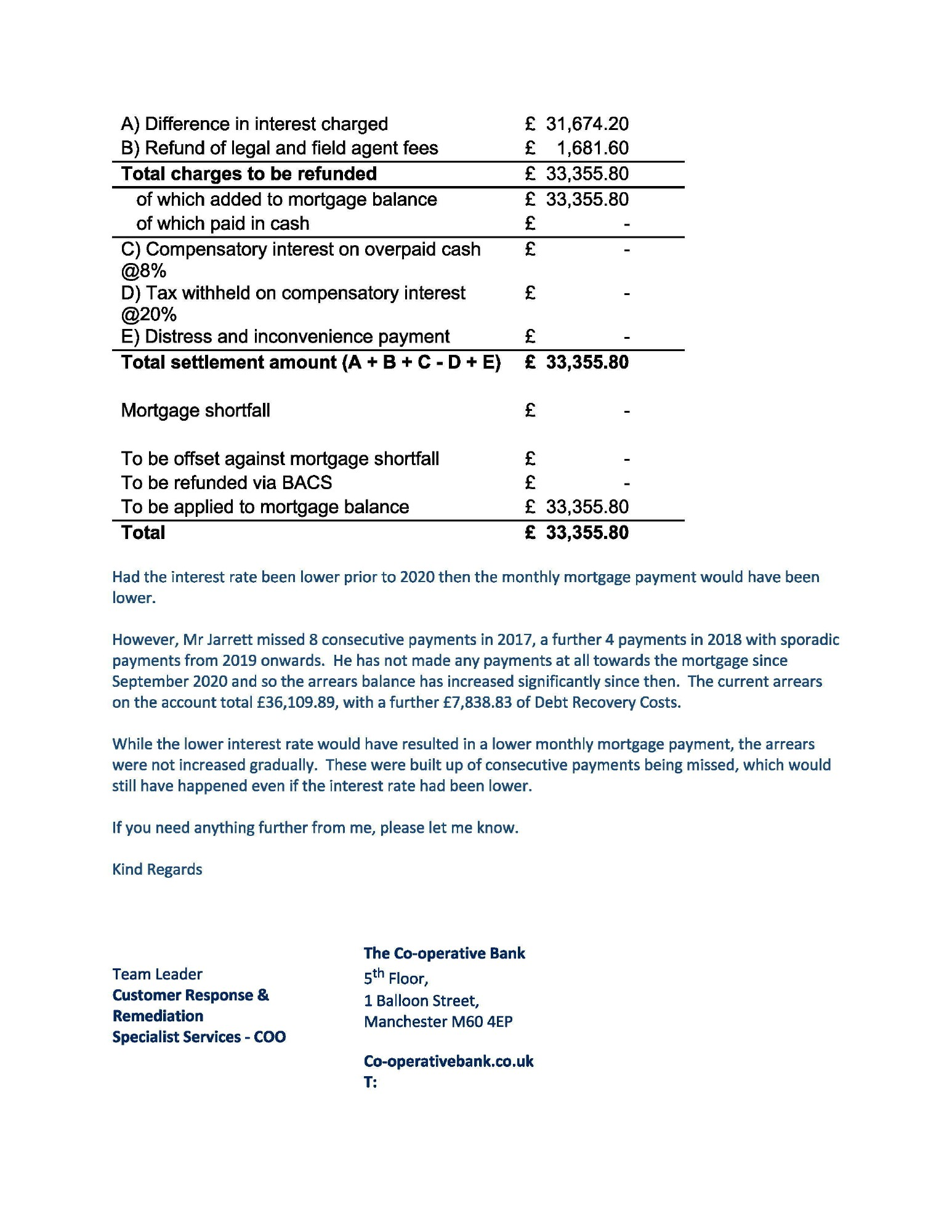
The Bank gave a £33,355.80 redress total and an R172 report of transactions and the as-charged running balance. It said missed payments meant arrears would still have arisen at the lower rate. Its own reconstruction shows no arrears, or a credit, every day from 12 March 2014 to 21 April 2023, including both possession actions. I did not accept the earlier redress; the firm credited it to my account on 21 October 2024.
E-FOS-12, pp.1–5. The viewer includes the reply and R172 ledger; identifying details are masked.
This extract is from the Bank’s own day-by-day reconstruction (E-CON-14). Its four columns are original balance, original arrears, reconstructed balance and reconstructed arrears. From 28 February to 18 April 2019 the original arrears column shows £3,074.01, rising to £4,098.68 from 22 March. The reconstructed arrears column shows nil every day, including the days of my crash.
Website image rendered from Jon’s selected April balance.pdf. The original PDF is preserved outside the website package.
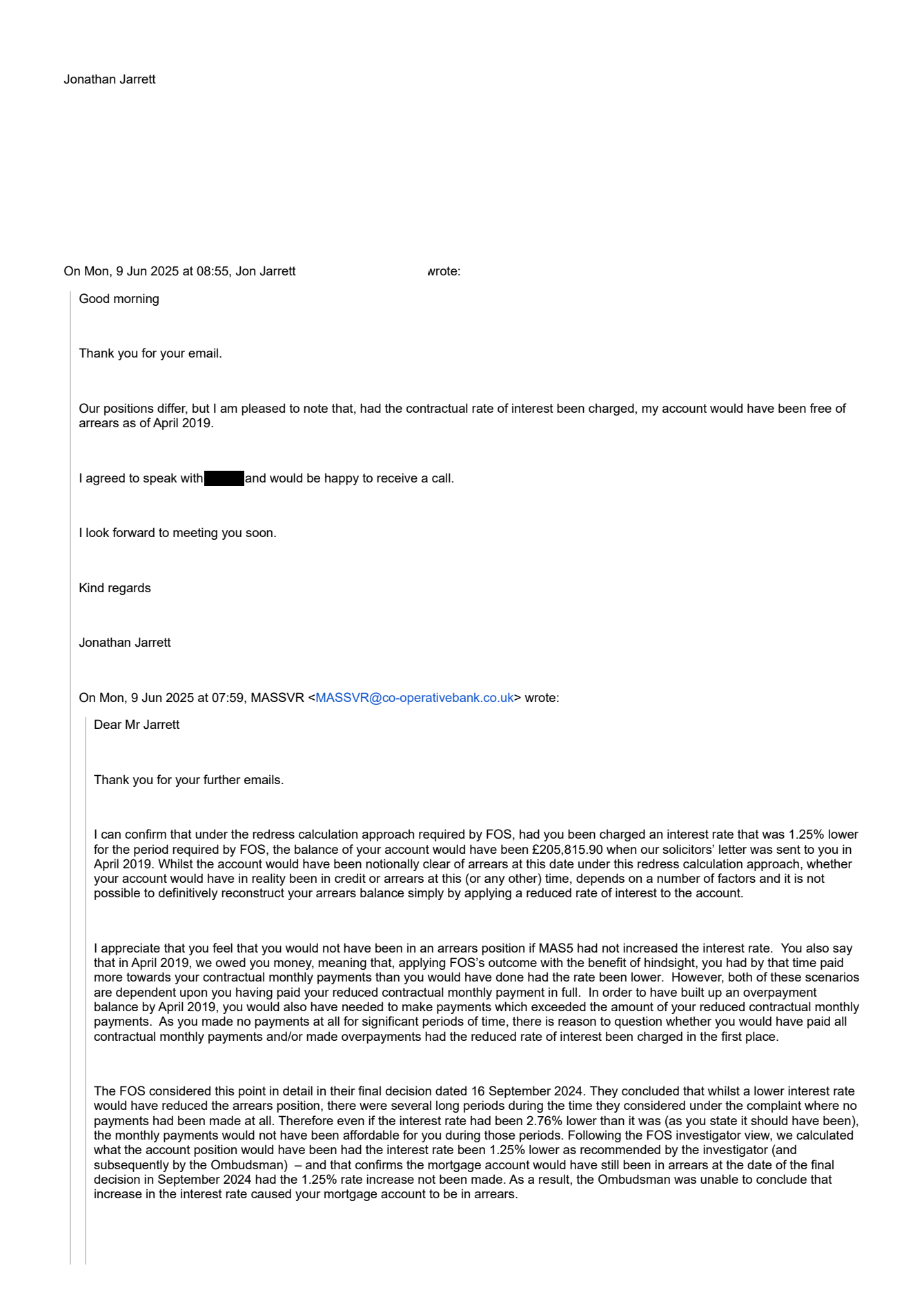
Under the Ombudsman’s limited redress method, the Bank said the account at the time of the April 2019 solicitor’s letter would have been “notionally clear of arrears”. It qualified that statement by questioning what payments I would have made at a lower rate.
The email did not say whether the dated reconstruction had been sent to the Ombudsman.