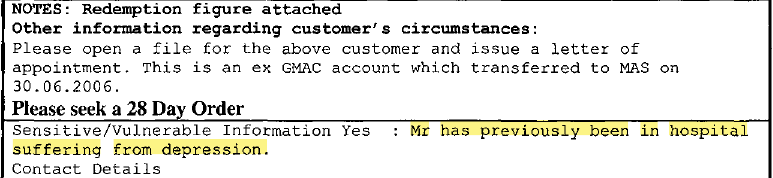
Several of the call notes below came without dates, in the data the Bank supplied after I applied to the High Court for it. Where a note is undated, the date or month comes from the note’s own contents.
22 November 2019 · seven months after the crash“Need to discuss exit strategies”
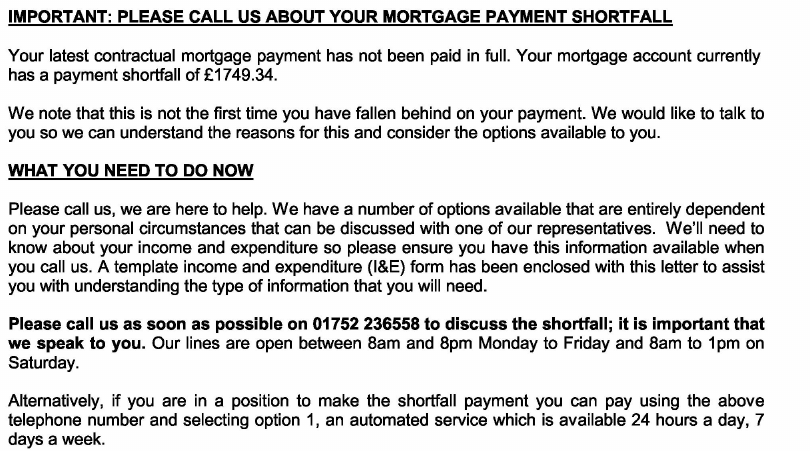
Seven months after the crash that the Bank’s own records say I was lucky to survive, I was still recovering from a traumatic head injury. On 22 November the Bank’s note recorded that my “arrears will increase to 4.71 months”, and set its next step: “Need to discuss exit strategies with MR or possibility of account returning to Lit.” Its investor presentation had already described the business my mortgage sat in as “targeted for run down or exit”.
The notes either side of it record “No payment available”, that the “Consequences of us not seeing the arrears situation improve” had been covered again, and that the “Importance of evidencing improvement of circumstances has been advised”. My hopes of recovery were noted too: “Positivity-in-theory needs evidencing though.”
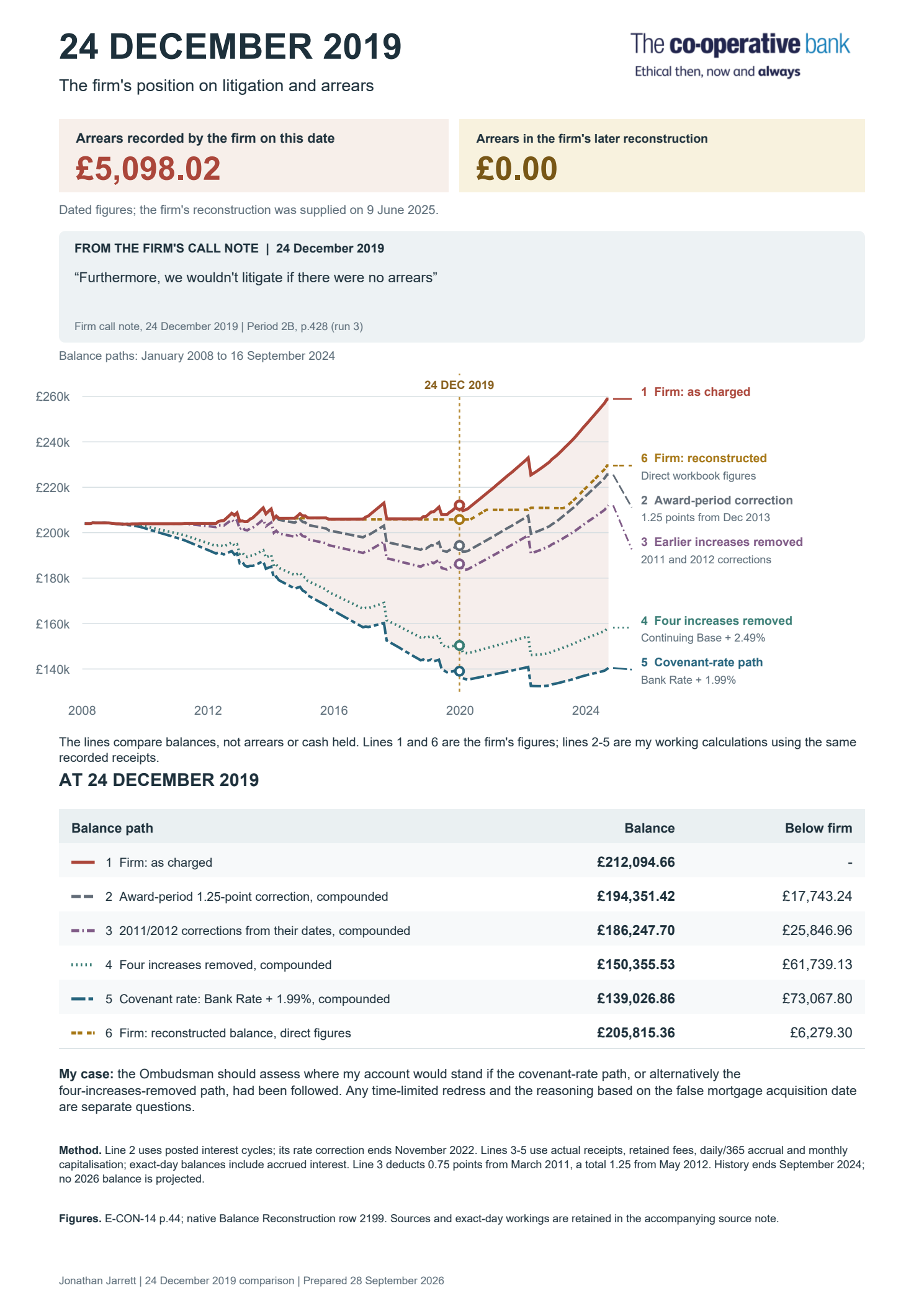
Yet the Bank’s own reconstruction, using the Ombudsman’s limited correction, shows no arrears, or a credit, every day from 12 March 2014 to 21 April 2023. See the missing letters →

Read the two November notes either side
Co-op DSAR 2(1), physical p.342, cropped to the lines quoted (the date comes from “Further CMI due today, 22/11” and the September 2019 payment it mentions); pp.354 and 351 (an almost identical copy of p.351 is at p.340). Undated as supplied. “Lit.” is the Bank’s litigation team. The investor presentation is on the business model page.
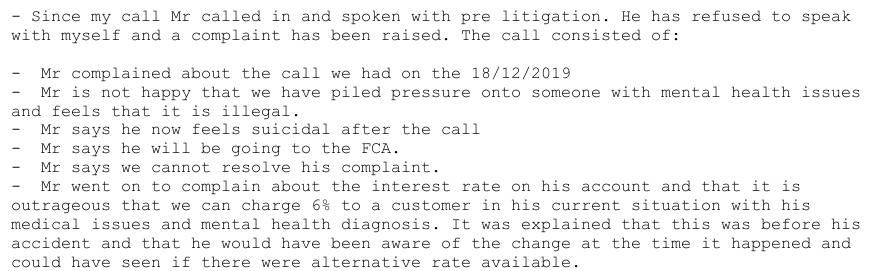
18 December 2019 · complaint recorded“Mr says he now feels suicidal after the call”
The Bank recorded my call that day as a complaint about the pressure I had experienced that morning. I don’t know whether I called to complain. The Bank says it keeps call recordings for three years, and my complaint was with the Ombudsman within three years of the call, but no call recording has been disclosed to me, so we may never know. What the record does describe is my wish to contact the FCA, my objection to the interest rate and my distress. It records suicidality twice, and the outcome it records me asking for was that the firm stop chasing the alleged arrears and threatening eviction. The next day, I was persuaded to complain to the firm rather than go to the FCA. That was the problem.
“Mr again threatened to commit suicide so again I tried to assure him that I will raise his complaint and tried to calm him down.”
Read the complaint summary

E-VUL-08, p.1 (printed p.17), cropped below identifying fields. The highlights are in the supplied exhibit. The handler’s descriptions are reproduced as the Bank’s record.
19 December 2019 · internal complaint routePersuaded to let the firm investigate
I say I was seeking help from the regulator. The next day’s note records that the handler persuaded me to use the firm’s process:
“I managed to convince mr that his complaint can be escalated and investigated impartially on site, rather than him going to FCA.”
Read the 19 December note

E-VUL-17, p.1; also FOS overall p.99. The FCA and FOS are different bodies. The note records that I felt the broker had inflated my annual income (at £90k). In fact, the broker had recorded my income correctly, at less than that figure.
19 December 2019 · CSAT referralVulnerability recorded in a litigation referral
The CSAT form is labelled “Referral Category: Litigation” and “Care Reason: Mental Health - Impairment”. It records concussion and daily memory loss. Later in the same form it records my new suicidal distress after the 18 December call, then proposes issuing the pre-action notice.
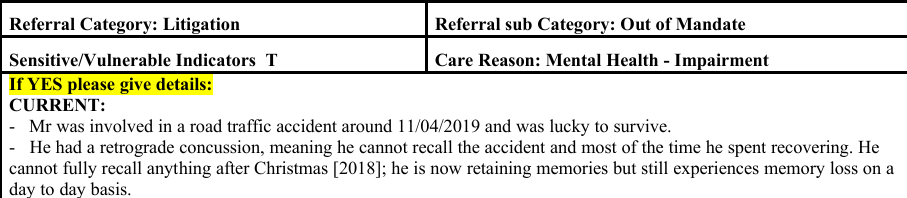
Read the current-distress and proposed-action extracts

CSAT Universal Referral Form, 19 December 2019, pp.1, 7–8; Co-op DSAR 2(1), physical pp.407, 413–414. This is the firm’s internal collections and vulnerability record, not an independent medical assessment. Its later part records the fresh distress.
23 December 2019 · decision authorisedPre-action notice unless I accepted the sale route
The decision authorised a pre-action notice at the close of business on 4 January if I did not wish to use AVS—or if I was unavailable for the booked call. It considered the mortgage unsustainable. It also told staff to be mindful of health comments and escalate them to the appropriate authorities where necessary. I ask what safeguarding action was actually taken.

Read the continuation, including its safeguarding instruction

CSAT Universal Decision Form, 23 December 2019, control RUS7812; run-4 Period 2B pp.396–398. The operative extracts are from pp.397–398. MPAP is the pre-action notice referred to in the Bank’s records.
24 December 2019 · the Christmas Eve letterAccept Assisted Voluntary Sale—or an intention to take legal action
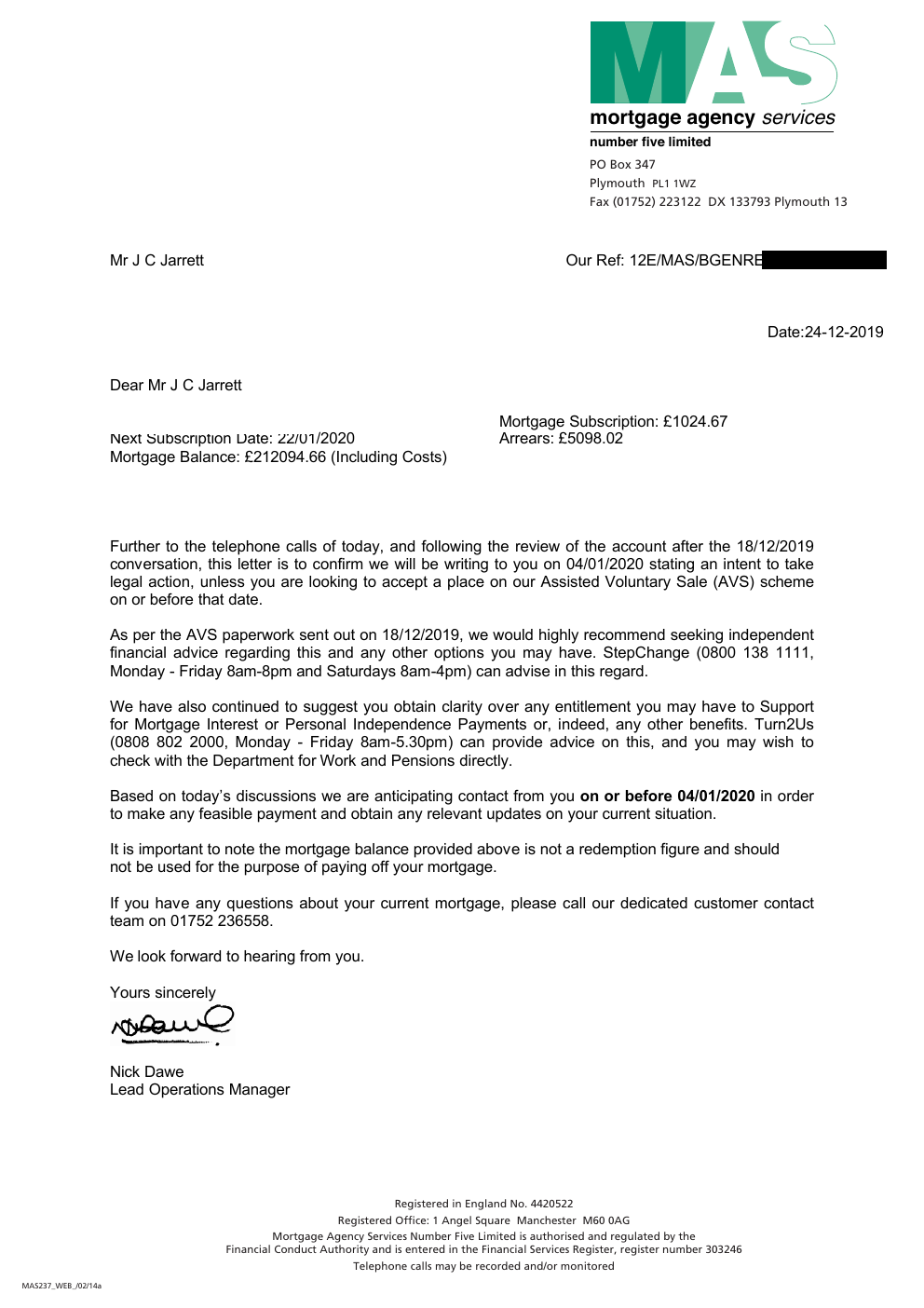
The letter said the firm would write on 4 January 2020 stating an intention to take legal action unless I was looking to accept a place on its Assisted Voluntary Sale scheme by then. It gave alleged arrears of £5,098.02.

E-VUL-15, p.1; also FOS overall p.87. Select the extract to read the full letter with my address and account reference masked. It is a stated intention to take legal action, not an order for immediate possession.
Late December 2019 · the Christmas period“Mr wanted to know if we had a court date”
Over the Christmas period, with a taxi waiting to take me to the train to visit family, I asked the Bank whether there was a court date. The handler confirmed there was none, then made clear the call was “NOT regarding the outstanding complaint”. The same note records: “Mr reiterated he is complaining to the FCA, made a payment yesterday [£250]”. Days after the firm recorded that it had persuaded me to let it investigate instead of going to the FCA, I was still saying I would go to the FCA.
Another note from the same days repeats the ultimatum: “I confirmed if he doesn’t accept AVS by 04/01/20, we will write out to confirm intent to litigate. 15 working days / 21 actual days later, Litigation will begin to act on the account.” I had said that “selling would be a last resort”. The note’s answer: if I had not accepted the sale by 4 January, “we can consider his now-understood disinterest in AVS to remain true”.
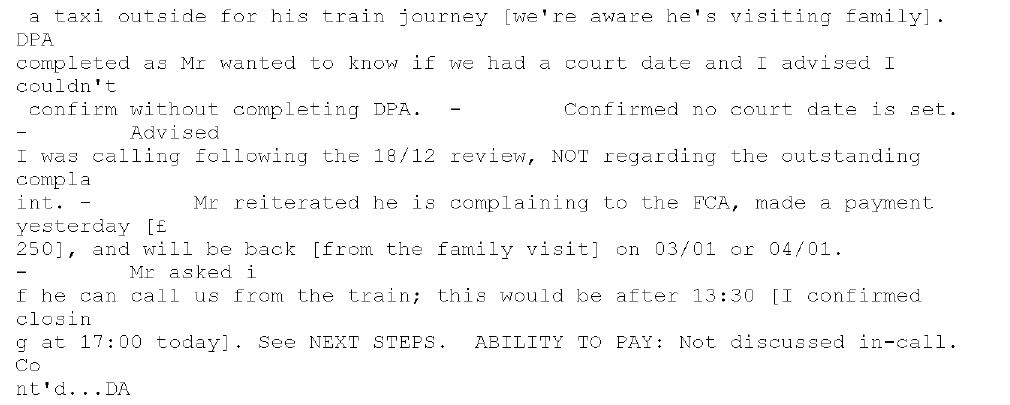
Read the “accept AVS by 4 January” note
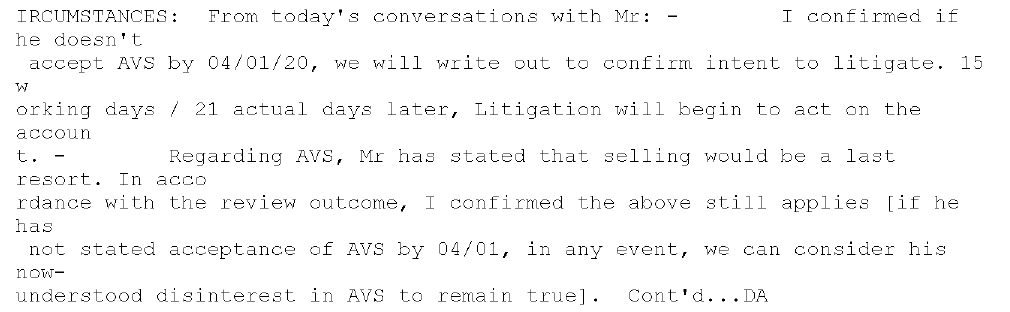
Co-op DSAR 2(1), physical pp.386 and 390, each cropped to the lines quoted; the rest of each note repeats my account history. Undated as supplied: both notes refer back to the 18 and 19 December calls and forward to 4 January. AVS is the Bank’s Assisted Voluntary Sale scheme.
4 January 2020 · the deadline arrivesTake in lodgers, ask about selling, or litigation
The Christmas Eve deadline arrived. The Bank’s note of 4 January told me to take in up to three lodgers, to seek advice “about his mortgage options, including AVS”, and to call by 22 January “so that we can determine whether litigation can be avoided”. It records: “We signposted Mr to Shelter.” Shelter is the housing and homelessness charity. And: “Mr is aware that if he does not call us back, then when MPAP expires on 27/01/20 we will immediately pass his account to Litigation.”
My complaint about the 18 December call was still open. Twelve days later, the Bank rejected it, with £0 redress.

Co-op DSAR 2(1), physical p.378 (also DSAR 2(2), p.470); the date comes from its heading, “’OC’s from 04/01/20”. The first half of the same note, at p.385, records that the pre-action notice (MPAP) was about to be issued and would expire on 27 January.
16 January 2020 · complaint rejectedMy distress complaint ended with £0 redress
In its statement of case to the Ombudsman of 13 January 2022, the Bank described its 16 January 2020 letter only as its answer to my complaint “about the sale and transfer of his mortgage”, and said it did not consent to the Ombudsman considering “any element of that complaint”. That same letter had also answered my complaint about the 18 December call. Yet the Bank’s own contemporaneous records described my serious head injury, continuing concussion and memory difficulties, and recorded that it had persuaded me to let it investigate internally.
The Final Decision mentions the December events, but I have not identified a separate determination of my complaint about the suicidal distress and pressure to sell. Nor have I identified a separate decision addressing how those recorded difficulties affected my ability to refer that complaint in time. I ask the Service to address both questions on the full evidence.
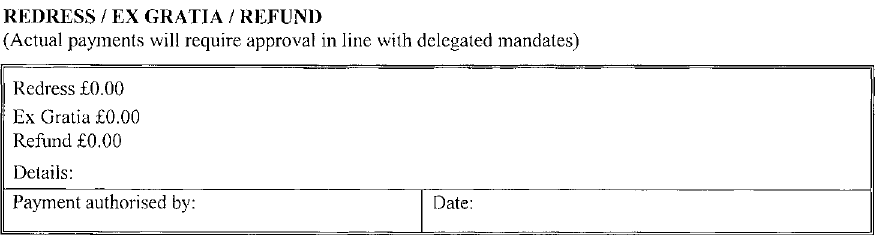
The internal investigation called the conversation cordial and robust, recognised that it had upset me, and recorded that pre-action correspondence had been issued while the complaint was open. It rejected the complaint. The sign-off records £0 redress, £0 ex gratia and £0 refund. The firm said it had attempted further outcome calls; the record does not establish that an outcome conversation took place.
Read the recorded decision and redress
E-VUL-08, pp.2–3 (printed pp.18–19); E-VUL-09 is the separate 16 January final response and internal sign-off. This describes the December complaint outcome.