The arrears question · 2024–2025
What were the arrears from time to time?
The Ombudsman asked for a recalculated history. The Bank supplied a total and an explanation about missed payments. The Decision relied on the Bank’s calculation; the Bank later relied on the Decision.
This is the sequence I challenge. A balance or arrears figure at one later date does not establish what the arrears would have been at earlier enforcement dates.
01 · 31 May 2024
What the Ombudsman asked
The investigator asked, on the Ombudsman’s behalf, for contact notes and correspondence from 2009–2015, a redress calculation, and confirmation of the account position from 2014 onwards if the lower rate had been applied. The question expressly included:
“what impact would that have had on the level of arrears on the account present from time to time”
That was a request for the position through time, not merely a single total refund.
 Read the request · both pages ↗
02 · 5 June 2024
The Bank’s reply did not answer that question
The Bank said the calculation had been completed. It supplied an aggregate redress figure of £33,355.80 for the period 8 January 2014 to 30 November 2022, consisting of £31,674.20 interest and £1,681.60 fees. It then referred to missed payments and the arrears recorded at the time of its reply. I did not accept the earlier redress; the firm credited it to my account on 21 October 2024.
“While the lower interest rate would have resulted in a lower monthly mortgage payment, the arrears were not increased gradually. These were built up of consecutive payments being missed, which would still have happened even if the interest rate had been lower.”
Its own reconstruction shows no arrears, or a credit, every day from 12 March 2014 to 21 April 2023, including both possession actions.
The five-page exhibit contains the reply and an R172 transaction ledger. The ledger shows the recorded account; it does not show the requested recalculated arrears at each date under the lower rate. My criticism is that a response was sent, but the specific question remained unanswered.
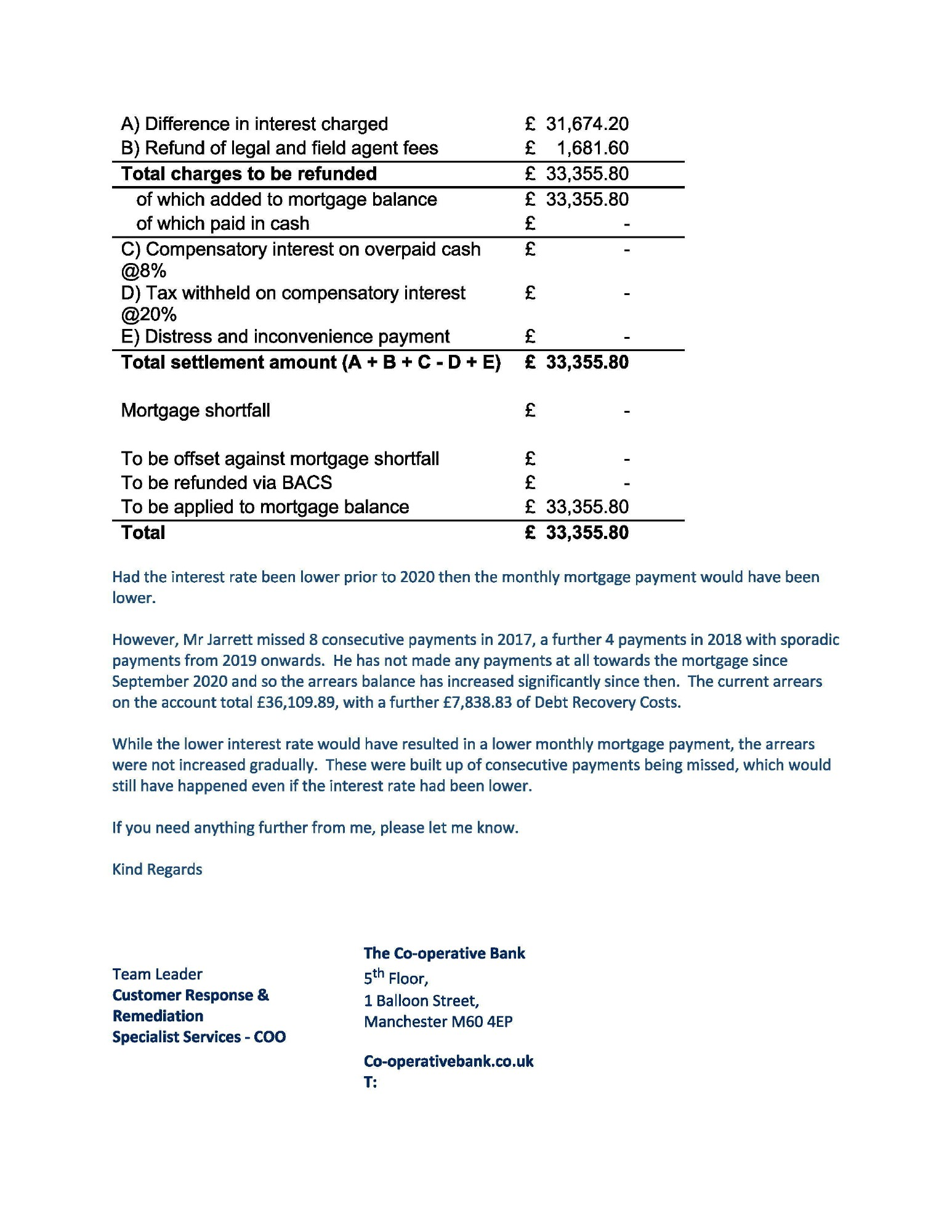 Read the reply and ledger · all five pages ↗
03 · 16 September 2024
How the Decision used the Bank’s calculation
At page 17, the Final Decision relied on periods without payments, considered whether even a 2.76-point reduction would have made payments affordable, and said:
“MAS5 has calculated what the account position would have been had the interest rate been 1.25% lower as recommended by the investigator (and now by me in this decision) – and that confirms the mortgage account would still be in arrears now had the unfair rate increases not been made.”
The Ombudsman then said she was unable to conclude that the unfairly high rate had caused the account to be in arrears. That is the Decision’s reasoning. My objection is that being in arrears “now” did not answer what the corrected arrears were when enforcement took place earlier.
04 · 9 June 2025
The later admission—and reliance on the Decision
A year later, the Bank confirmed that, under the FOS redress method, the balance when its solicitors wrote in April 2019 would have been £205,815.90. It acknowledged:
“the account would have been notionally clear of arrears at this date under this redress calculation approach”
The Bank qualified that statement: it said the real-world position depended on other factors, questioned what payments I would have made at a lower rate, and said a definitive reconstruction could not simply assume a reduced rate. Those qualifications are included in the linked document. Its own reconstruction shows no arrears, or a credit, every day from 12 March 2014 to 21 April 2023, including both possession actions.
On 9 May 2019, a month after my head injury, my mother paid the Bank £5,123.35 by card. The Bank would not cancel the possession hearing unless the alleged arrears were paid, and would not wait for a cheque. On 13 May the court adjourned the claim “upon the arrears having been cleared in full”. On the Bank’s own reconstruction there were no arrears to clear.
It then relied on the Ombudsman’s September 2024 reasoning:
“The FOS considered this point in detail in their final decision dated 16 September 2024.”
The email repeated the argument about periods without payments and the account still being in arrears at the date of the Final Decision. It used that reasoning to answer my challenge about the earlier account position. The selected PDF copy includes my same-day reply immediately before the Bank’s quoted email.
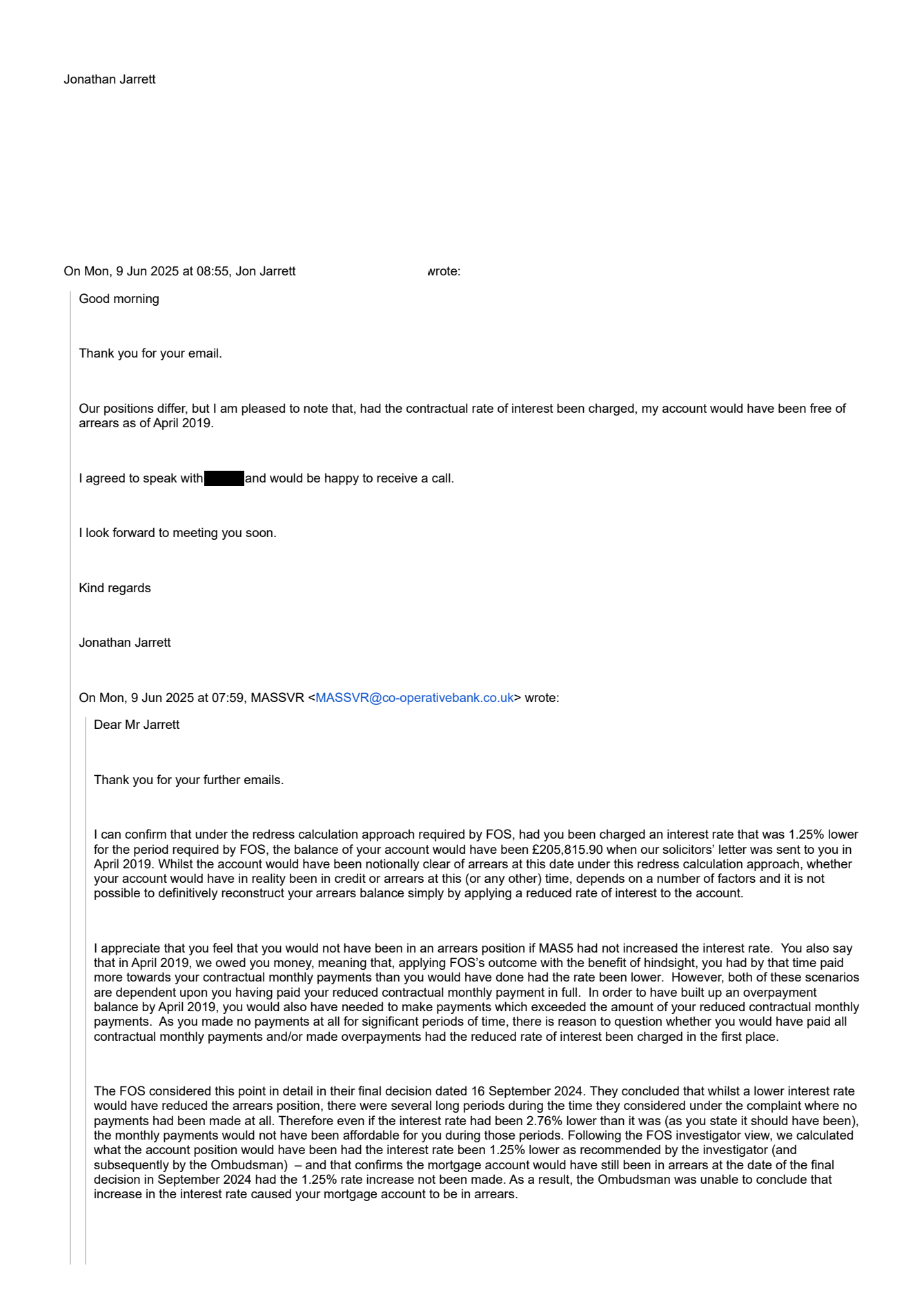 Read the email thread · both pages ↗
Thirty-eight threats, against the covenant rate
Between April 2012 and April 2025 I was sent at least 38 letters threatening solicitors or possession. They are scheduled in E-ANA-08. Each red dot is the arrears a letter alleged. The line shows how far the Bank’s recorded balance stood above my calculation at Bank Rate + 1.99%, from the first breach in December 2008, with the same recorded payments and charges (E-ANA-03).
For every letter that stated a figure, the excess over that rate was more than three and a half times the arrears alleged. At the August 2019 possession threat, it was 67 times. The shaded band is the Bank’s own limited reconstruction, which shows no arrears, or a credit, every day from 12 March 2014 to 21 April 2023.

The line is my working calculation, not a Bank figure. It measures a difference in balance, not arrears or cash held. From 21 October 2024 the recorded balance includes the £34,105 the Bank credited, which I did not accept.
All 47 dates 38 letters and 9 court steps
| Date | Letter or court step | Arrears alleged | Bank’s own reconstruction | Above Bank Rate + 1.99% | Source |
|---|---|---|---|---|---|
| Possession threat | £889.03 | Before its series | £12,904.18 | Topaz Batch 2, p. 12 | |
| Account to be passed to solicitors | £3,911.84 | Before its series | £15,821.17 | Topaz Batch 2, p. 63 | |
| Take legal action | £3,911.84 | Before its series | £15,729.93 | Topaz Batch 2, p. 64 | |
| Account to be passed to solicitors | £3,867.76 | Before its series | £17,183.27 | Topaz Batch 2, p. 76 | |
| Account to be passed to solicitors | £3,867.76 | Before its series | £17,079.66 | Topaz Batch 2, p. 81 | |
| Move to litigation | — | Before its series | £17,840.48 | Bank diary | |
| Possession order over your property | £4,845.72 | Before its series | £17,827.51 | Topaz Batch 2, p. 84 | |
| Possession threat | £1,457.22 | Before its series | £20,930.33 | Topaz Batch 3, p. 16 | |
| Account to be passed to solicitors | £3,416.48 | Before its series | £22,343.82 | Topaz Batch 3, p. 26 | |
| Move to litigation | — | Before its series | £23,012.85 | Bank diary | |
| Commence legal action | £4,396.11 | Before its series | £23,000.22 | Topaz Batch 3, p. 32 | |
| Possession order over your property | £4,396.11 | Before its series | £22,886.45 | Topaz Batch 3, p. 44 | |
| Possession order over your property | £5,375.74 | Before its series | £23,281.48 | Topaz Batch 3, p. 88 | |
| Possession hearing | — | Before its series | £23,496.35 | Court order: Co-op DSAR 2 (4), p. 153 | |
| Instructing our solicitors | £2,355.37 | Before its series | £24,287.18 | Topaz Batch 3, p. 92 | |
| Commence legal action | £2,355.37 | Before its series | £24,036.61 | Topaz Batch 3, p. 96 | |
| Possession order over your property | £3,335.00 | Before its series | £24,457.50 | Topaz Batch 3, p. 99 | |
| Restored hearing; claim adjourned generally | — | £0.00 | £25,254.58 | Ground 8, para. 26 | |
| Possession threat | £979.63 | £0.00 | £31,389.24 | Topaz Batch 4, p. 11 | |
| Possession threat | £1,378.54 | £0.00 | £48,726.33 | Topaz Batch 4, p. 70 | |
| Possession threat | £1,024.67 | £0.00 | £62,775.43 | Topaz Batch 5, p. 30 | |
| Account to be passed to solicitors | £3,074.01 | £0.00 | £64,996.34 | Topaz Batch 5, p. 45 | |
| Account to be passed to solicitors | £3,074.01 | £0.00 | £65,521.61 | Topaz Batch 5, p. 54 | |
| Account to be passed to solicitors | £3,074.01 | £0.00 | £65,597.44 | Topaz Batch 5, p. 60 | |
| Move to litigation | — | £0.00 | £66,594.89 | Bank diary | |
| Commence legal action | £4,098.68 | £0.00 | £66,563.00 | Topaz Batch 5, p. 69 | |
| Possession order over your property | £4,098.68 | £0.00 | £66,403.30 | Topaz Batch 5, p. 85 | |
| Possession order over your property | £5,123.35 | £0.00 | £66,915.64 | Topaz Batch 5, p. 137 | |
| Claim adjourned “upon the arrears having been cleared in full” | — | £0.00 | £67,096.46 | Court order, quoted above | |
| Possession threat | £1,024.67 | £0.00 | £69,206.74 | Topaz Batch 5, p. 164 | |
| Take legal action | £5,098.02 | £0.00 | £72,749.58 | Topaz Batch 6, p. 42 | |
| Account to be passed to solicitors | £4,998.02 | £0.00 | £72,934.43 | Topaz Batch 6, p. 44 | |
| Possession threat (firmer wording) | £7,202.40 | £0.00 | £77,983.56 | Topaz Batch 6, p. 87 | |
| Instructing our solicitors | £6,337.92 | £0.00 | £81,509.62 | Topaz Batch 6, p. 144 | |
| Instructing our solicitors | £8,214.60 | £0.00 | £83,098.48 | Topaz Batch 6, p. 160 | |
| Field-agent visit | — | £0.00 | £84,516.96 | Field-agent record, E-LIT-02 | |
| Account to be passed to solicitors | £11,029.62 | £0.00 | £85,173.65 | Topaz Batch 7, p. 21 | |
| Account to be passed to solicitors | £11,029.62 | £0.00 | £85,258.97 | Topaz Batch 7, p. 24 | |
| Account to be passed to solicitors | £12,906.30 | £0.00 | £86,643.89 | Topaz Batch 7, p. 75 | |
| Account to be passed to solicitors | £13,844.64 | £0.00 | £87,425.75 | Topaz Batch 7, p. 80 | |
| Move to litigation | — | £0.00 | £87,355.27 | Bank diary | |
| Commence legal action | £13,844.64 | £0.00 | £87,347.43 | Topaz Batch 7, p. 83 | |
| Possession order over your property | £17,598.00 | £0.00 | £90,394.55 | Topaz Batch 7, p. 218 | |
| Claim struck out | — | £0.00 | £91,171.53 | Court order: 2021 claim page | |
| Possession threat | No figure stated | £8,820.29 | £110,340.52 | Topaz Batch 8, p. 93 | |
| Commence legal action | No figure stated | After its series | £86,368.00 | Co-op DSAR 3, p. 4 | |
| Account to be passed to solicitors | £18,021.29 | After its series | £91,257.71 | Topaz Batch 9, p. 27 |
Letters: E-ANA-08, with the arrears each letter stated. Bank’s own reconstruction: E-CON-14, a daily series from 18 December 2013 to 25 October 2024. On 3 January 2024 the Bank’s ledger recorded arrears of £30,742.09; its own reconstruction, £8,820.29. The last column is the Bank’s recorded balance less my Bank Rate + 1.99% balance on the same day (E-ANA-03). Within a month, my calculation includes interest accrued to that day, while the Bank’s figure is its last posted balance.
The correct financial starting point
That problem goes beyond the Co-operative Bank’s answer to the investigator. It concerns the financial starting point used to decide whether the bank’s charging caused the arrears.
In June 2024, the bank told the Ombudsman that its calculation was complete. The historical reconstruction subsequently disclosed to me showed the account continuously clear of arrears, or in credit on that calculation, from 12 March 2014 to 21 April 2023. That period includes both the 2019 and 2021 possession actions. The bank must explain when that historical calculation was available and why its answer to the investigator did not set out the arrears position at the relevant dates. A redress total and an assertion about missed payments did not answer the question asked.
Even that reconstruction uses only the Ombudsman’s limited correction. My fuller case begins with the first breach of the restrictive covenant: the November 2008 rate reduction was not implemented within the permitted month, making 7 December 2008 the first day beyond the deadline.
Whether borrowers could enforce the covenant directly is a separate question from what it required the purchaser to do, what protection it provided, and what its operation means for a fair assessment of the account. The Ombudsman’s task is to decide what is fair and reasonable in all the circumstances, taking the relevant law into account. My case is that the protection and the duty to reduce the rate were concealed from me. Had I known those facts, I could have challenged the missed reduction when it happened.
The historical account can therefore be tested on more than one basis. One reconstruction applies the continuing covenant-rate case from the first breach. Another removes all four SVR increases, totalling 2.76 percentage points. In the lead Davies case, the Ombudsman expressly found:
“As a result, the changes to the SVR MAS5 made between 2009 and 2012 – which collectively added 2.76% to the SVR – were not made for reasons permitted by the contract.”
That finding directly supports testing my account with all four increases removed and following their financial effects through time. Whether the Service limits the redress it awards remains a separate question from what those increases did to the account and the arrears relied upon for enforcement.
The starting question should be: what would the account, and the customer’s financial position, have been if the bank had charged what it was entitled to charge? The bank should not retain the benefit of excessive charging and then rely on the customer’s difficulty meeting those demands as proof that the charging caused no harm.
The same applies to other debts. Before treating credit-card balances or borrowing elsewhere as independent reasons for financial difficulty, the Service needs to examine why that borrowing arose. Money used to meet excessive mortgage demands was money unavailable for food, bills and other commitments. Borrowing to cover that gap could generate further interest and deepen the difficulty.
The bank itself described a three-month arrears trigger for litigation. Faced with the prospect of losing their home, borrowers may try to meet mortgage demands by borrowing elsewhere. That possibility requires investigation when assessing affordability and causation.
To illustrate the mechanism, I modelled the extra monthly mortgage demands as hypothetical credit-card borrowing. The illustration assumes that each monthly difference was borrowed at 39.9% effective annual interest, with no repayments. It excludes the separate costs of my flat and lost rent. It is not a statement of my actual card debt or a compensation calculation; it shows how financing the extra demands could compound the financial pressure.
My objection is that the Ombudsman used the bank’s recorded arrears as a starting point without resolving how much of that position resulted from the charging under challenge. Findings about affordability, other debts and responsibility for arrears must be reassessed against the corrected history. Otherwise, the consequences of the disputed charging risk becoming the justification for excusing it.
Where did the money for the extra demands come from?
I say the Bank benefited considerably from charging an exorbitant SVR. The money to meet the extra demands had to come from customers. Where did it come from—and how much came from borrowing? The Service needs to examine the use of income, savings, help from others and borrowing, rather than treating the resulting financial difficulty as independent of the mortgage demands.
Financing the demands above Bank Rate + 1.99%
If I had borrowed on a credit card to meet each extra monthly mortgage demand, this illustrates how the borrowing and interest could have grown (the modelled cost above Bank Rate plus 1.99%).
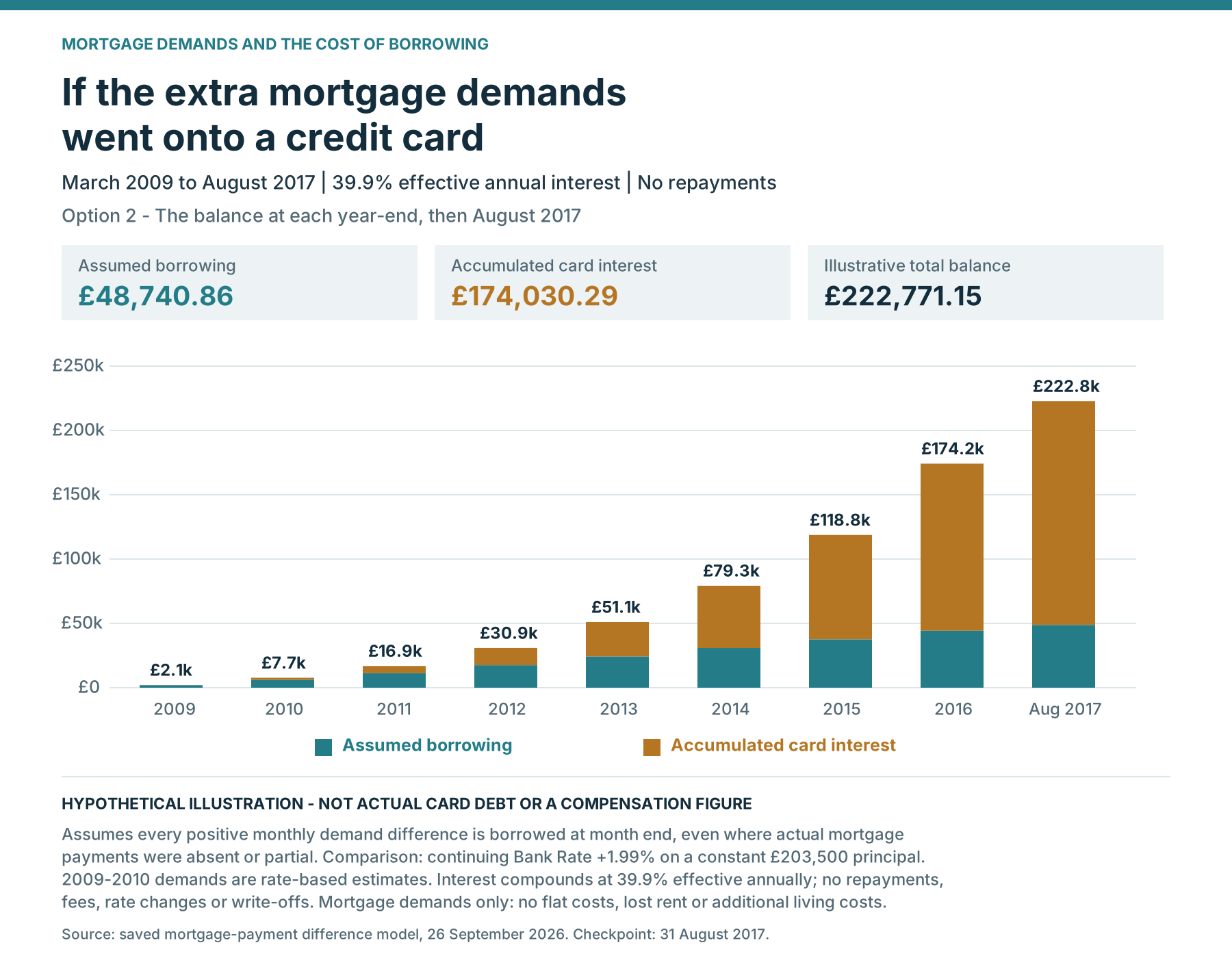
This illustration compares monthly demands with continuing Bank Rate + 1.99% on a constant £203,500 principal. It assumes every positive difference was borrowed, including months when actual mortgage payments were absent or partial; the 2009–2010 demands are rate-based estimates. It runs from March 2009 to August 2017 at 39.9% effective annual card interest with no repayments.
The four-increase illustration: 2014 to the 2024 Decision
The second graph uses the 2.76 percentage points represented by the four increases the Ombudsman in the lead Davies case found were not made for reasons permitted by the contract. It covers only January 2014 to 16 September 2024, rather than the whole period from the earlier increases.

This is a fixed-principal illustration: £479.28 borrowed each full month, calculated from £208,382.16 at a constant 2.76-point difference. The last advance is prorated to 16 September 2024. It does not reconstruct the actual changing rate gap, mortgage balance or receipts. It assumes 39.9% effective annual card interest and no repayments; it is not a schedule of actual excess payments.
The Bank relied on arrears remaining in 2024. Its June 2024 reply did not set out that the historical reconstruction later disclosed to me showed no arrears in 2021, when I complained—even under its limited 1.25-point correction. The Service needs to examine that earlier position, rather than use a later arrears balance to answer it.
I have taken the second financing illustration through to the September 2024 Decision to show how financial pressure could accumulate during that period. I rely on the dated account evidence for my contention that the Bank misled the Ombudsman. The graph illustrates the possible financing mechanism.
These are two alternative hypothetical scenarios, not amounts to add together. Neither is my actual credit-card debt, a verified loss or a compensation figure. Both exclude the costs of my flat, lost rent and additional living costs. The Bank’s 1.25-point historical reconstruction, the covenant-rate comparison and the constant 2.76-point financing illustration serve different purposes.
The point I ask the Service to confront
I say the Bank’s answer returned to me with the authority of the Ombudsman’s Decision behind it, without supplying the dated calculation originally requested. The later admission about April 2019 makes the unanswered question concrete.
My case is that the Service must examine the corrected arrears at the actual enforcement dates, using the recorded receipts, and explain how those results affect its findings. A later figure under the Bank’s limited method does not establish arrears at the earlier enforcement dates. My full contractual account remains the primary case; the Bank’s limited reconstruction is corroboration, not a limit on the correction I seek.