Coordinated conduct and disputed consent: leaving my home, losing the rent from my flat, and discovering records of an agreement I say I never made.
In short
I say the Bank did not give me all my personal data before the Ombudsman’s decision, and I still do not have it all. Hundreds of the pages it disclosed in 2025 lacked date fields.
In 2025 the Bank recorded that I had agreed to a 0% rate and an arrangement to pay. I had not agreed. I have repeatedly asked for the evidence that I agreed to the arrangement they recorded. The responses have not answered that question.
Leaving my home
During the Ombudsman’s original investigation I did not see the connection between the pressure I was under and what I did to cope with it, so I did not explain that from March 2014 until I sold my Cambridge flat in August 2017, I was living in that flat rather than in my mortgaged home.
The Co-operative Bank’s pursuit of alleged arrears—telephone calls, letters and field agents coming to the door—had made being at home unbearable. I moved into my buy-to-let flat in central Cambridge because I could no longer manage the stress. That meant carrying the costs of both properties while losing the rent the flat would otherwise have produced. In 2017, I was admitted to hospital after a serious deterioration in my mental health. I subsequently sold the flat.
At the time, I did not fully understand the connection between the pressure I was experiencing, my decisions and the harm that followed. Therapy in 2026 has helped me begin to understand experiences that I now regard as institutional abuse.
I say the Bank did not give me all my personal data before the Ombudsman’s decision, and I still do not have it all. Before I brought a High Court claim, I made subject access requests to the Bank in 2022 and repeatedly in 2025, and each time received only a small bundle of papers. In 2025, after bringing the claim, I obtained further personal data from the Co-operative Bank. I say some of those documents were fabricated, and seeing them had a devastating effect on my health. Even then I did not see the Bank’s servicing diary; it had never been disclosed to me. Topaz sent me its disclosure in December 2025, but I could not look at it until May 2026: I had realised the significance of the fabricated documents and needed to see a therapist. May 2026 was the first time I saw the diary.
Hundreds of the pages the Bank disclosed in 2025 lacked date fields, which made the history difficult to reconstruct, and some documents were repeated nine times in a row. Undated 2012 call notes were placed on either side of my 2022 High Court statement, and the same sheets were passed to Topaz (see April 2019). One of them also says I was due £50,000 from the ambulance service; I dispute the £50,000 figure and the note’s characterisation of my injuries and employment. I will send the undated documents to the Financial Ombudsman Service. I have already sent the Service’s legal department records I obtained only after I started a High Court claim, asking whether my Ombudsman had seen them. My question was never answered. If my request for reconsideration ends in a judicial review, the Administrative Court will see the whole file, and the lack of evidence will be the evidence.
I worked in the NHS until 10 April 2019, the day before my head injury, and was registered as a paramedic until 2025; I had hoped to return. I doubt I will ever drive again, or indeed be the same again, and I am now medically retired. What happened to me in April 2019 is why the Ombudsman needs to look at the earlier history of the account, which the Co-operative Bank did not give her at the time. My work history →
I asked for a meeting
The Ombudsman had found that I had been treated unfairly by the enforcement action taken in 2019. After the head injury that occurred at that time, I was regarded as a vulnerable adult and a safeguarding concern. That is still the case today. I had not really taken in the Ombudsman’s finding until early 2025: I had been concentrating on the interest rates. Subsequent disclosures showed that my account was being managed from the Co-operative Bank’s Manchester office.
In summer 2024 I stopped the Support for Mortgage Interest payments because I did not intend to affirm the contract. My position was that the interest-rate increases had not been made in accordance with the mortgage terms and conditions, and that the Bank’s conduct had caused me considerable harm. That was my reason for withholding payment.
The Bank sent field agents to my door again. I did not speak to them. Then, in a letter dated 23 April 2025, it demanded redemption of the mortgage in full within 15 working days, warning that otherwise the account would be passed to solicitors for legal action which could result in repossession. It later said its legal action was paused; I say there was never going to be any, because it was waiting to hand me over to Topaz.
I wrote to the Bank on 8 May 2025. I have supplied that letter to the Financial Ombudsman Service, but I have not located a copy in either the Bank’s or Topaz’s subject-access disclosures. I explained the problems my head injury had caused, that I no longer worked, and my view that the Bank had caused considerable harm. I wanted a meeting to discuss its conduct.
When I asked further questions about my account, the Bank told me on 22 May that these had been passed to its Directors, who would be in touch separately. An email sent on behalf of a senior executive of the Bank offered a face-to-face meeting after a review of my financial position. In all, the Bank offered a meeting on three occasions.
On 9 June 2025 the Bank wrote to me: “we do not have a record of receiving a DSAR from you, but will raise this now.” Its own servicing diary records “DSAR request processed” on 5 June, four days earlier, and the papers being sent on 11 June.
I was told that I first had to provide details of my income and expenditure. I initially refused. When I eventually supplied the information to obtain the promised meeting, the Bank recast that call as my seeking support. The meeting did not take place. Instead, the Bank applied a zero interest rate and recorded that I had agreed to it.
The Bank also created records stating that I had agreed to a zero-interest arrangement. I say that record of agreement was fabricated. I had stopped paying, and I had made it clear, including to the hundreds of people on my mailing list, many of whom I had helped complain about the Bank, that I did not believe any court would uphold a contract after years of relentless repossession pressure that had left me injured. I say the Bank needed a record showing that I had affirmed the contract before it passed my mortgage to Topaz, and that this was the purpose of the meeting it promised me. I say I was coerced into handing over my financial information and sensitive information about my disability.
Providing financial information to obtain a meeting was not my agreement to a new arrangement. I had made my objections clear in writing and had told the Bank that its treatment had nearly killed me. I wanted those concerns addressed. In 2025 I sent at least 58 emails to the Co-operative Bank/MAS5, many documenting my dissatisfaction. During that correspondence, I was never given the option to refer those complaints to the Financial Ombudsman Service.
The emails and letters
25 June 2025, 09:23 · The Bank
The “support” email
“Thank you for sharing with my colleague [name removed] your current financial position and your personal circumstances so we can consider how best to support you at this time.”
The same email proposed 0% interest and ended:
“Please let us know if you would like us to implement the reduced interest rate…”
My account
The price of the meeting
I didn't give my financial position so that the bank could consider how best to support me. I never once asked for support. The bank deals in assertion, not evidence. When did I ask for support? Who does the bank think is going to rely on that statement when it's seen in court? Does it have any evidence for its assertion? The details of my financial position were the price of the meeting.
25 June 2025, 14:08 · My reply
I asked about the promised meeting
“Please can you confirm that you have retracted your offer of a meeting?”
26 June 2025, 10:22 · My email
The rate offer in context
In the email I asked:
“could you kindly explain why you did not offer me a zero-interest rate in April 2019?”
I was not giving the Bank permission to apply the rate. I was continuing to challenge its conduct, not agreeing to its proposal.
I had stopped the Support for Mortgage Interest payments in summer 2024 because I did not intend to affirm the contract. I made no payments after that email; the only payment the Bank received was the single £610 SMI payment, which I addressed in my written notices. I made no agreement to a payment plan. The firms should identify the agreement they say I made.
The Bank later told Topaz that it had “unilaterally applied” the rate, and that I “had not asked them to apply one”.
26 June 2025, 12:37 · The Bank’s acknowledgment
The Bank promised to review and respond
Dear Mr Jarrett
Thank you for your emails from yesterday and this morning.
I can confirm receipt of these and we will review the contents carefully. We will respond to you in due course.
Kind Regards
MASSVR
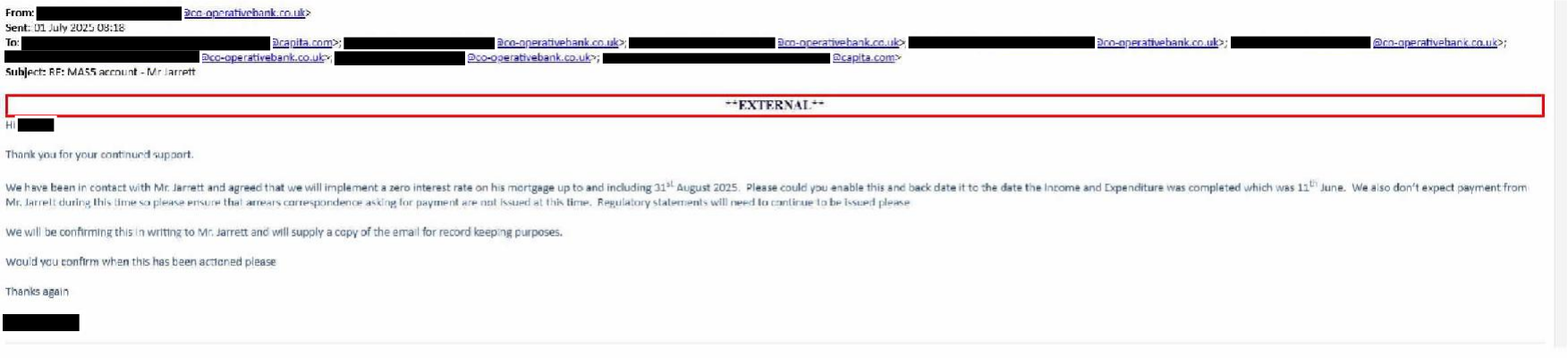
1 July 2025 · The Bank’s internal instruction
The Bank’s assertion of agreement
“We have been in contact with Mr. Jarrett and agreed that we will implement a zero interest rate on his mortgage up to and including 31 August 2025.”
The email asks for the rate to be backdated to 11 June, for arrears correspondence asking for payment to stop, and for regulatory statements to continue. It says the Bank will confirm the position to me in writing and supply a copy for the record.
The day after the Bank’s internal instruction asserting an agreement, I wrote to the person at the Bank who had promised me a meeting, copied to its MAS5 mortgage mailbox:
“You have tricked me into handing over my financial information by being untruthful and saying that you would meet me to discuss my mortgage.”
The same day I also wrote:
“I think that this call was more of a fishing expedition so that you could tick a few boxes.”
“Now I think that you are going to make me homeless, or sell my mortgage to Topaz and they will make me homeless, but I did not do anything wrong.”
I reminded the Bank of the crisis I had had the year before, and wrote: “I will not survive a repossession.”
Well, I wasn't in a good place then, but I am now. Even so, it matters that the Service looks at how I was treated in the year after my complaint was decided. I say that conduct is new evidence: together with the personal data I say the Bank has still not given me, it bears on the reliability of the account the Bank gave of its earlier treatment of me.
Two days later, the servicer’s internal email recorded that I had “consented”.
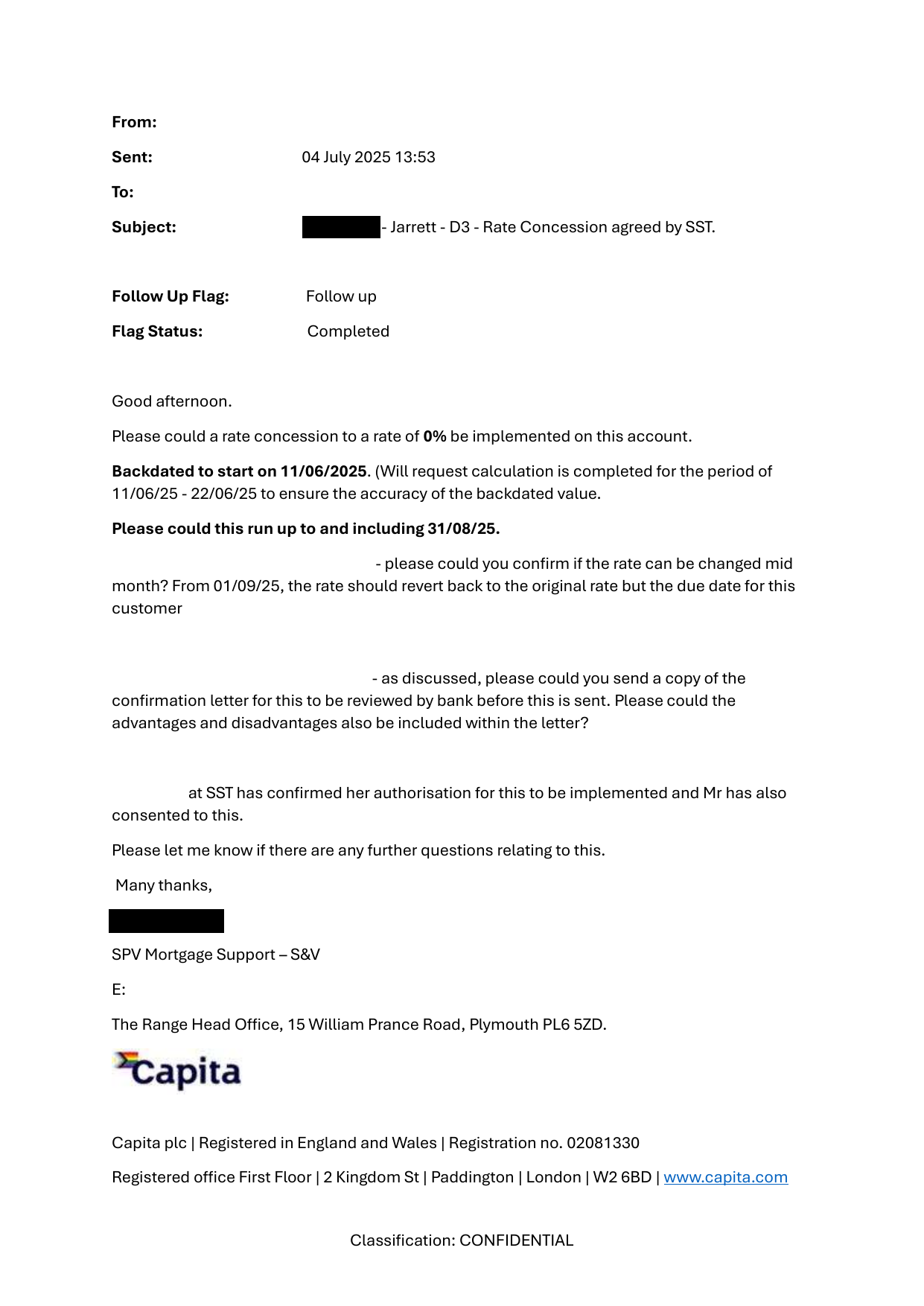
4 July 2025, 13:53 · A Capita servicing employee
The internal assertion of consent
This email requests a 0% rate backdated to 11 June 2025, running to 31 August 2025. It asks for the confirmation letter to be reviewed by the Bank before it is sent and states:
The letter said the Bank had “now implemented a zero interest rate on your mortgage”: implemented, not agreed. It also said:
“As we have completed a review of your circumstances and put measures in place to assist whilst you wait for your SMI claim outcome, we do not feel a face to face meeting would be productive.”
Bank letter, 9 July 2025, page 2 (E-DEN-01).
17 July 2025 · MAS5’s letter
“Confirmation of Interest Rate Concession”
The letter dated the concession from 11 June 2025, the day of the call, although the servicer’s own note of that call reads “SOLUTIONS OFFERED / AGREED ACTIONS N/A”. It referred to “the agreed period”, and said the concession would be reported to the credit reference agencies as an “arrangement”, which “shows other lenders that you have agreed a plan with us”. Under the heading “What happens if I change my mind?”, it said:
“You have 10 days to change your mind from the date of this letter. If you have arrears and choose not to proceed with this arrangement, you’ll continue to receive contact from us.”
I had not agreed. There was no agreement for me to change my mind about.
28 July 2025, 09:19 · My email
My express non-acknowledgment
“I expressly do not acknowledge or admit the existence of any debt, arrears, or liability to MAS5/The Co-operative Bank.”
I also stated that any DWP payment would be made:
“under economic duress and without my voluntary consent.”
8 August 2025 · My reply
When the Bank proposed extending the rate
The Bank proposed extending the 0% rate and invited me to contact it if I wished to decline. I replied:
“I do not acknowledge the debt. I do not accept the legitimacy of the arrears.”
13 August 2025, 13:07 · My email
My objection to an impression of affirmation
Earlier in this email I described an attempt to induce me into:
“affirming the contract and accepting forbearance measures (neither of which I did)”
I then wrote:
“this manipulation — this ham-fisted attempt to extract an impression of affirmation — is yet further evidence that you have repudiated the contract.”
26 August 2025 · My email
Termination notice and SMI handling
Previous notice. I refer to my Notice of Termination and Litigation Hold dated 11 August 2025. The mortgage contract is at an end; I accepted your repudiatory breach. Alternatively, I treat the contract as rescinded. Nothing here is affirmation or waiver.
SMI handling. Any SMI paid by DWP is received under duress and under protest solely to mitigate possession risk while proceedings are live. Please hold any SMI in suspense, do not treat it as an acknowledgment or affirmation, do not report it to CRAs as an admission, and preserve full allocation logs.
30 September 2025 · MAS5’s letter
The same letter again
Another letter with the same heading and the same wording extended the “concession” to 22 October, still dated from 11 June.
By then I wasn’t engaging with any of it: I had terminated the contract and been to court, so there was nothing left for me to decline.
3 October 2025 · My letter to Eversheds
“Not accepted”
I sent the 30 September letter to Eversheds and told them its content “does not alter my position” and “is not accepted as correct as to liability or sums said to be due”.
I say these letters were simply building a paper trail, and that writing to a vulnerable customer in that way, after years of repossession attempts, is coercion.
In August 2025, I went to the High Court seeking to stop the proposed transfer of my mortgage until the data issues were resolved. My witness statement explained why I had participated in the financial-information call and that I had not accepted forbearance or affirmed the contract. I also said I was concerned the Bank might have known in 2019 that I was being pursued for arrears I did not owe. The application was adjourned with liberty to restore.
After the account transferred to Topaz Finance in October, I applied in my personal-data proceedings to stop registration of the transfer and enforcement. On 23 October 2025, the same day the court referred that application for listing, Topaz extended the zero interest rate for four months; it later wrote that its reasons included allowing time for the transfer to be registered at the Land Registry and for my injunction application “to fall away”. Facing a claim for about £9,000 in costs, I did not press the application, and on 31 October it was dismissed without an order for costs. The judge later clarified in writing that the “totally without merit” designation concerned that application only, not the merits of my underlying claims, and that because it had been presented to him as agreed, he had not been invited to disagree with it. I contend that the extension was intended to prevent my injunction application from succeeding.
The credit reporting compounded my concerns. The Bank had said that an arrangement marker would tell other lenders that I had agreed a plan. My Experian record subsequently showed a Topaz “Arrangement to Pay” with a start date of 1 November 2025. I dispute that reporting because I had not agreed such a plan. That displayed start date does not establish when the marker was first reported or when I first saw it.
On 2 December 2025 Topaz wrote: “As your account is currently on a 0% concession, we also report that there is an arrangement in place.” I had not agreed to any arrangement, and I did not know about it until I involved the FCA by copying it into my emails.
I say the evidence shows Topaz was very keen to secure my mortgage, and to record me as having agreed an arrangement I never agreed.
The marker appeared anyway. My Experian record, last updated on 21 September 2025, shows no arrangement. My credit report of 3 April 2026 shows an “arrangement” from October 2025 to February 2026, after I had terminated the contract, been to court and told Eversheds that the letter’s content was not accepted.
Topaz’s solicitors later said the rate was a forbearance measure that did not need my agreement, while continuing to defend the accuracy of the credit reporting.
Despite my notice of 26 August 2025, the Bank reported to credit reference agencies that I was in an arrangement to pay. Topaz subsequently did the same. Eversheds, which had acted for both lenders, then wrote on behalf of MAS5 and the Co-operative Bank on 28 April 2026 that I had not “raised concerns” about that reporting previously.
In fact, I had raised MAS5’s credit reporting with Eversheds on 1 October 2025, asking for the basis of the “missed” payments and for every monthly submission to the credit reference agencies, including any arrangement marker. I chased that request on 11 February 2026 because I had received no reply.
I had also asked Topaz, on 6 November 2025, to confirm that no adverse reporting had been or would be made on disputed arrears, and to identify the dates and credit reference agencies if any such reporting existed. Those were earlier, specific challenges to the reporting.
I had not agreed to a zero-interest arrangement or a payment plan. Having made my position clear in writing, I did not expect to have to check my credit file to make sure my wishes had been respected. Discovering records at the end of 2025 which I say fabricated my consent, and then confronting the credit reporting and this response, caused significant harm to my mental health.
The arrears history is wrong too. The Ombudsman’s Final Decision told MAS5 to recalculate my mortgage at the lower rate, and said: “This will result in changes to the arrears balance from time to time, and so MAS5 should also amend Mr J’s credit file to reflect the revised position” (pages 23–24). The Bank’s own reconstruction shows no arrears, or a credit balance, every day from 12 March 2014 to 21 April 2023, and in July 2025 it told me that MAS5 “has accepted the final FOS decision and has redressed you accordingly”. Yet both records above still show me in arrears, month after month, through years when the Bank’s own reconstruction shows no arrears: “missed” on Experian, and arrears codes rising to “6” (six months or more behind) on the 2026 report. When I asked, the Bank said the account “would have been notionally clear of arrears” in April 2019, but that “it is not possible to definitively reconstruct your arrears balance”. The Ombudsman asked for exactly that reconstruction, and for the credit file to follow it.
The file passed to Topaz
With the FCA looking on, from a distance, Topaz gave me its subject access response on a memory stick. I say Topaz has been supplied with, and is willing to use, a curated repossession file, curated to defeat any claim I have. It was arranged to suggest that an injury had ended my paramedic career before 2019, and that I had affirmed the contract. My own Ombudsman’s Final Decision was not located in it; another borrower’s was. Eighty whole pages are blacked out, and my objections are out of chronological order, separate from the Bank’s curated version. I doubt my correspondence would be in the file at all if I had not made a subject access request and copied in the FCA. The Bank’s own disclosure contains a very crisp email stating plainly that I had consented to the zero interest rate. The only remaining problem is finding the agreement itself. Fabricating documents is serious, especially while High Court proceedings are on foot.
Eversheds Sutherland, for the Bank, still refers to “MAS 5’s agreement to apply a 0% interest concession”. I say Eversheds and the Bank are using that wording to make it appear that I agreed to an arrangement I did not agree to. TLT, for Topaz, replied to my 18 June 2026 letter about the file on 16 July that it is accurate, but did not tell me I could refer it to the Ombudsman, and no final response came within eight weeks. So I have referred it.
I have repeatedly asked for the evidence that I agreed to the arrangement they recorded. The responses have not answered that question: where is my agreement? It remains awkwardly unanswered.
“MAS5 informed us that they had decided to place your account on a 0% concession…”
Topaz said it had neither been given the rationale nor been consulted about implementation.
Topaz/Aspiro’s letter, answer 7, p. 4.
11 and 12 February 2026 · My emails
Had the Bank said I consented?
On 11 February, copying the FCA, I asked Topaz for the second time whether the Bank had told it that I had consented. The next day I told the Bank’s solicitors, again copying the FCA, that I had never discussed interest rates with the Capita employee whose email recorded my consent, and asked for any record of it.
18 February 2026, 16:35 · Topaz/Aspiro
The second response
Answering the question I had renewed on 11 February, Topaz wrote:
“The Co-operative Bank informed us that they had unilaterally applied a 0% concession to your account – in other words, they informed us that you had not asked them to apply one.”
That avoided the question I had asked, which was whether I had consented. I had neither requested nor agreed to the rate or an arrangement. Where was the evidence of my consent?
16 April 2026, 15:12 · My formal notice
I asked for the precise evidence of any agreement
“If your clients contend that I ever discussed, requested, accepted, or agreed to any 0% interest arrangement, or any other arrangement said to affect my legal position, then identify by return the precise document, call note, recording, email, letter, or other contemporaneous record relied upon.”
The FCA was included among the recipients. A week later, Eversheds Sutherland said it was no longer instructed by Topaz, which subsequently used TLT; the reason for the change of solicitors remains unexplained.
28 April 2026 · Eversheds Sutherland for MAS5 and the Co-operative Bank
The final response on credit reporting
Paragraphs 5–12 are reproduced below with their original paragraph numbers.
In your 16 April 2026 you complain that MAS 5 falsely reported, to credit reference agencies, that your mortgage account was in an arrangement.
As this is not something you have raised concerns about previously, our clients have investigated this as a new complaint and you can treat this as our clients’ final response letter.
Our clients’ investigations
To investigate your complaint, our clients have reviewed their records and the correspondence relating to MAS 5’s agreement to apply a 0% interest concession to your mortgage account.
Our clients do not accept that any credit reporting undertaken in relation to your mortgage account was false. On the contrary, our clients were entitled, and in certain respects obliged, to report the status of your account to credit reference agencies in accordance with applicable regulatory, contractual and industry requirements.
The Bank, in a letter dated 9 July 2025, confirmed that it had implemented a zero interest rate concession in respect of your mortgage account and confirmed that this would remain in place until the end of September 2025.
Similarly, MAS 5, in letters dated 17 July 2025 and 30 September 2025 communicated to you the action it was taking, namely that it was reducing the interest rate to 0%. Both letters advised you to get in touch, within 10 days of the date of the respective letters, if you did not think the arrangement was right for you.
Reporting this as an “arrangement” to credit reference agencies was, in any event, to your advantage. The alternative would have been to continue reporting that your account was in arrears.
Final response
As your 16 April 2026 email raised a new complaint not previously raised with us or our clients, as per paragraph 6 of this letter, you may treat this letter as our clients’ final response to your complaint regarding credit reporting, as summarised above.
Eversheds Sutherland, 28 April 2026, paragraphs 5–12. This response concerns MAS5 and the Co-operative Bank. Topaz/Aspiro’s own final response is a separate letter dated 8 June 2026.
The firms still need to explain how that correspondence justified recording my consent to a plan and reporting an “Arrangement to Pay”, particularly when Topaz subsequently described the rate as unilaterally applied.
What it did to me
Seeing a record saying I had consented, when I had not, left me feeling I could not protect my position. I told the Financial Ombudsman Service that I felt as if I was being attacked by two mortgage lenders at the same time, and I still do. By February 2026, when I had seen only the Co-op’s disclosure, I was panicking and struggling to cope, so I organised therapy. My therapist was concerned and needed to make a safeguarding report to my GP. Another third party made a safeguarding report. In my view, this is what happens when two mortgage lenders and a firm of solicitors coordinate their actions to ensure that your home is repossessed.
Last year another Co-operative Bank (MAS5) customer died. He had become a good friend, and he had also stood up to the Bank. I did not know when I first went to the High Court on 21 August 2025: he had died a month earlier, and I had been unable to contact him. It is time for a public body to step in. If none does, I will make an application to the Administrative Court, and we can have some much-needed judicial oversight. I struggle to get things written, but now that I have other help, I can manage.
To me, it feels as though I am living someone else’s life, though less so today. I have accepted that the Bank will do whatever it can to win, and I am more centred; I have become used to it. When you have worked alone on a response car for many years, you learn that you are on your own. You deal with whatever comes along, and it becomes second nature. It was a great career, and it made me self-reliant and resilient. I now know that I have always had ADHD, which made life incredibly difficult, and after my head injury that difficulty was compounded a hundred times. When I found the documents I say the Bank fabricated, and saw what I say was the Bank working with Topaz, I needed help myself. I started ADHD medication, and it has been life-changing; my problem since the injury has been executive function. Those documents put me out of action for a while, as did the file passed to Topaz, but I will bounce back. Looking back, I realise that what I was put through, as many others were, was a very nasty form of institutionalised abuse. It went on for so long that I didn’t question it, and even now it is difficult to believe that I was not really in arrears. I say the Bank framed the investigation around four interest-rate increases; what happened before and after them was not in the frame.
Accountability
For me, this is a question of accountability. Banks, lenders and the solicitors acting for them must answer for the records they create and the conduct they pursue. Institutions entrusted with protecting customers must also answer for how they respond when those records and that conduct are challenged.
I have previously spoken to journalists about the Co-operative Bank. It is a tragedy for any homeowner to lose the place they live, particularly a family, and my case is no worse than anyone else’s. But for the “ethical” Co-op, it is not a good look when a customer is seriously injured while his bank is pursuing him for arrears, and it then turns out, as I say, that the Ombudsman was never told the answer to the question she asked: that on the Bank’s own figures there were no arrears at the time. If that customer was working in the NHS the day before, it is an awkward story. I say the Bank would rather curate a repossession file and have Topaz use it than attempt repossession itself, and that is why it has curated a file that will leave me defenceless in court.
In April 2026 I sent the documents I say were fabricated to a journalist. I had objected in emails to the Bank in 2025, did so again in 2026, and sent those emails to the FCA as well.
I can only ask for a reconsideration in my own case and have that decision judicially reviewed if needed. So this is what happened to me; other people were treated just as badly and often worse.
The Service needs to consider its obligations as a public body, and its own claims about how it treats vulnerable customers and adults at risk.
Where the public bodies responsible for protection fail, I believe their decisions must be open to scrutiny in the High Court.


I was not giving the Bank permission to apply the rate. I was continuing to challenge its conduct, not agreeing to its proposal.
I had stopped the Support for Mortgage Interest payments in summer 2024 because I did not intend to affirm the contract. I made no payments after that email; the only payment the Bank received was the single £610 SMI payment, which I addressed in my written notices. I made no agreement to a payment plan. The firms should identify the agreement they say I made.
The Bank later told Topaz that it had “unilaterally applied” the rate, and that I “had not asked them to apply one”.